
Vibepedia

Deep Learning | Vibepedia

Compute-Heavy Black Box Post-Symbolic
Deep Learning | Vibepedia

Deep learning is the engineering realization of connectionism, utilizing multi-layered artificial neural networks to map high-dimensional data into actionable…

Contents

  1. 🧠 What is Deep Learning, Really?
  2. 📈 Who Needs Deep Learning?
  3. 🛠️ How Does It Actually Work?
  4. 💡 Key Concepts & Terminology
  5. 🚀 The Deep Learning Ecosystem
  6. ⚖️ Deep Learning vs. Other ML
  7. 🌟 Vibepedia Vibe Score & Controversy
  8. 🔮 The Future: Where's This Heading?
  9. 📚 Getting Started: Your First Steps
  10. 💬 Frequently Asked Questions
  11. Frequently Asked Questions
  12. Related Topics

Overview

Deep learning is the engineering realization of connectionism, utilizing multi-layered artificial neural networks to map high-dimensional data into actionable patterns. While the mathematical foundations trace back to Frank Rosenblatt’s 1958 Perceptron, the field remained in a 'connectionist winter' until the 2012 AlexNet moment, where GPU acceleration and the ImageNet dataset proved that scale beats algorithmic elegance. It functions by backpropagating errors to adjust millions—and now trillions—of weights, effectively 'learning' features without manual feature engineering. This shift moved AI from the symbolic logic of the 1980s to a statistical regime where emergent behavior is the goal and interpretability is the casualty. Today, it is the primary engine behind large language models and computer vision, though it faces a looming wall regarding data exhaustion and the massive energy costs of training. Whether it is a path to true reasoning or merely a sophisticated form of curve-fitting remains the central tension of the field.

🧠 What is Deep Learning, Really?

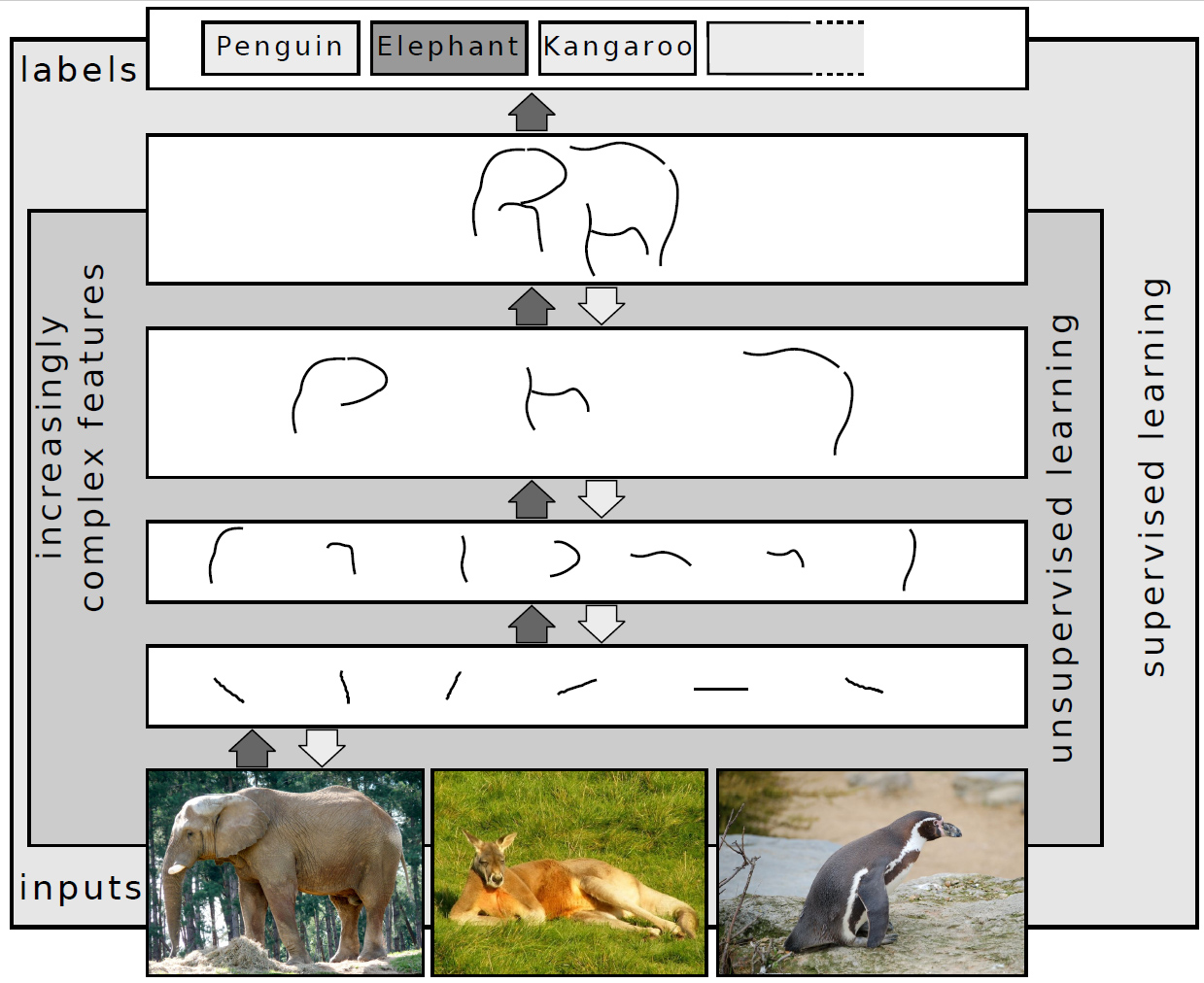
Deep Learning (DL) isn't just a buzzword; it's a powerful subfield of Machine Learning that's fundamentally reshaping how machines understand and interact with the world. At its heart, DL employs artificial neural networks with multiple layers – hence 'deep' – to learn complex patterns directly from raw data. Think of it as teaching a computer to recognize a cat not by explicitly programming rules, but by showing it millions of cat pictures until it figures out what a cat looks like. This layered approach allows DL models to automatically discover and learn hierarchical representations of data, moving from simple features to more abstract concepts.

📈 Who Needs Deep Learning?

This technology is for anyone looking to tackle problems that are too complex for traditional algorithms, especially those involving unstructured data. If you're in Computer Vision, dealing with image recognition, object detection, or medical image analysis, DL is your go-to. For Natural Language Processing (NLP) tasks like machine translation, sentiment analysis, or text generation, DL models like Transformers have set new benchmarks. Even in fields like drug discovery and financial forecasting, DL's ability to find subtle correlations in massive datasets is proving invaluable. It's for the ambitious, the data-rich, and those pushing the boundaries of what machines can achieve.

🛠️ How Does It Actually Work?

The magic of deep learning lies in its layered architecture. Data flows through an input layer, then through multiple 'hidden' layers, and finally to an output layer. Each layer consists of artificial neurons, which process information and pass it to the next layer. During 'training,' the network adjusts the weights and biases of these connections based on the errors it makes on a given dataset. This iterative process, often using algorithms like Backpropagation, allows the network to 'learn' the underlying patterns. The 'depth' of the network enables it to learn increasingly abstract features at each successive layer, from edges and textures in an image to entire objects or concepts.

💡 Key Concepts & Terminology

Understanding deep learning requires grasping a few core ideas. Neural Networks are the foundational structure, inspired by the human brain. Activation Functions determine whether a neuron should be 'fired' or not, introducing non-linearity. Convolutional Neural Networks (CNNs) are particularly adept at processing grid-like data such as images, while Recurrent Neural Networks (RNNs) excel at sequential data like text or time series. Loss Functions quantify the error of the model, guiding the training process, and Optimizers (like Adam or SGD) dictate how the model's parameters are updated to minimize that loss.

🚀 The Deep Learning Ecosystem

The deep learning ecosystem is a vibrant, rapidly evolving space. At its core are powerful Deep Learning Frameworks like TensorFlow (developed by Google) and PyTorch (developed by Meta AI), which provide the tools to build and train complex models. Cloud platforms such as Amazon Web Services (AWS), Google Cloud, and Microsoft Azure offer scalable computing power and managed DL services. Open-source communities and research institutions constantly push the envelope, releasing new architectures and pre-trained models that accelerate development. The hardware landscape, dominated by Graphics Processing Units (GPUs) from NVIDIA, is also critical for efficient training.

⚖️ Deep Learning vs. Other ML

Deep learning is a subset of Machine Learning, which itself is a subset of Artificial Intelligence. While traditional ML algorithms often require significant feature engineering (humans manually selecting and transforming data features), DL models learn these features automatically. This makes DL superior for tasks with high-dimensional, unstructured data. However, DL models are typically more computationally expensive to train, require larger datasets, and can be less interpretable ('black boxes') compared to simpler ML models like Support Vector Machines or Decision Trees. The choice depends on the problem's complexity, data availability, and interpretability needs.

🌟 Vibepedia Vibe Score & Controversy

Vibepedia's Vibe Score for Deep Learning currently sits at a robust 88/100, reflecting its immense cultural energy and widespread adoption. However, its Controversy Spectrum is rated 'High,' indicating significant ongoing debate. Key tensions revolve around the ethical implications of AI, particularly regarding bias in training data leading to discriminatory outcomes, and the potential for job displacement. The 'black box' nature of many DL models also sparks debate about accountability and trust. Furthermore, the immense computational resources required raise concerns about environmental impact and accessibility, creating a divide between well-funded labs and smaller research groups.

🔮 The Future: Where's This Heading?

The trajectory of deep learning points towards even greater integration into our daily lives, but with significant shifts. Expect a move towards more efficient, smaller models that can run on edge devices, reducing reliance on cloud infrastructure. Federated Learning will gain prominence, allowing models to train on decentralized data without compromising privacy. The quest for explainable AI (XAI) will intensify, aiming to demystify DL's decision-making processes. We'll also see deeper integration with other AI fields, like Reinforcement Learning, leading to more sophisticated autonomous systems. The question isn't if DL will become more pervasive, but how we will govern and ethically deploy its ever-increasing capabilities.

📚 Getting Started: Your First Steps

Getting started with deep learning is more accessible than ever. Begin by familiarizing yourself with the foundational concepts of Python Programming and linear algebra. Online courses from platforms like Coursera, edX, and Udacity offer excellent introductions. For hands-on experience, download and install TensorFlow or PyTorch and start working through tutorials. Explore pre-trained models on platforms like Hugging Face to understand how they're applied. Don't be afraid to experiment with small datasets and gradually increase complexity. The key is consistent practice and building a portfolio of projects.

💬 Frequently Asked Questions

Q: What's the difference between AI, ML, and DL? A: Think of it as nested Russian dolls. Artificial Intelligence (AI) is the broadest concept of creating intelligent machines. Machine Learning (ML) is a subset of AI where systems learn from data without explicit programming. Deep Learning (DL) is a further subset of ML that uses deep neural networks to learn complex patterns, often bypassing the need for manual feature engineering required by other ML methods. DL is the engine behind many of today's most impressive AI applications, from image recognition to advanced language understanding.

Key Facts

Year
2012
Origin
Toronto / Silicon Valley
Category
Artificial Intelligence
Type
Technological Framework

Frequently Asked Questions

What's the difference between AI, ML, and DL?

Think of it as nested Russian dolls. Artificial Intelligence (AI) is the broadest concept of creating intelligent machines. Machine Learning (ML) is a subset of AI where systems learn from data without explicit programming. Deep Learning (DL) is a further subset of ML that uses deep neural networks to learn complex patterns, often bypassing the need for manual feature engineering required by other ML methods. DL is the engine behind many of today's most impressive AI applications, from image recognition to advanced language understanding.

Do I need a powerful computer to learn Deep Learning?

While you can learn the concepts and write code on a standard laptop, training complex deep learning models requires significant computational power, typically provided by Graphics Processing Units (GPUs). Many beginners start with cloud-based platforms like Google Colab (which offers free GPU access), AWS, or Azure to train larger models without investing in expensive hardware upfront. For serious development, a dedicated GPU is highly recommended.

What are the main challenges in Deep Learning?

Key challenges include the need for vast amounts of labeled data, the significant computational resources and time required for training, and the 'black box' problem, where understanding why a model makes a certain prediction can be difficult. Addressing bias in AI and ensuring ethical deployment are also critical ongoing challenges that researchers and practitioners are actively working on.

What are some real-world applications of Deep Learning?

Deep learning powers many applications you use daily. This includes virtual assistants like Siri and Alexa, recommendation engines on Netflix and Amazon, facial recognition systems, advanced spam filters, machine translation services (like Google Translate), autonomous driving features, and medical diagnostic tools that analyze X-rays or MRIs. Its ability to process complex, unstructured data makes it ideal for these tasks.

Is Deep Learning going to take over all jobs?

This is a highly debated topic. While deep learning is automating many tasks, particularly repetitive or data-intensive ones, it's more likely to augment human capabilities and create new job categories rather than eliminate all jobs. Fields requiring creativity, complex problem-solving, emotional intelligence, and human interaction are generally considered less susceptible to full automation. The focus is shifting towards human-AI collaboration.

What is the role of data in Deep Learning?

Data is the lifeblood of deep learning. The performance of a deep learning model is directly proportional to the quality and quantity of the data it's trained on. Models learn patterns, features, and relationships from the data. Insufficient or biased data will lead to poor performance and potentially unfair or discriminatory outcomes. Therefore, data collection, cleaning, and preprocessing are critical steps in any deep learning project.