
Contents
Overview
Middle Persian evolved from Old Persian, the language of the Achaemenid Empire. Following the Islamic conquest of Persia in the 7th century, Middle Persian underwent significant changes, absorbing a substantial amount of Arabic vocabulary and adopting the Perso-Arabic script. This evolution gave rise to New Persian, which began to flourish in the 9th century with the emergence of epic poetry. Early literary giants like Rudaki, often called the father of Persian poetry, and later Ferdowsi with his monumental Shahnameh, solidified Farsi's literary prestige. The language became the lingua franca of administration and culture across vast swathes of Central Asia and the Indian subcontinent for centuries, influencing numerous other languages and literary traditions.
⚙️ How It Works
Farsi is an inflected language characterized by its relatively simple grammatical structure compared to some other Indo-European languages. It features a Subject-Object-Verb (SOV) word order, though this can be flexible for emphasis. Nouns do not have grammatical gender, and plurals are typically formed by adding the suffix '-ha' or '-an'. Verbs are conjugated for tense, mood, and person, often using auxiliary verbs. The language employs a rich system of prefixes and suffixes to derive new words. Its phonology includes a set of vowels and consonants that are generally similar to those found in Arabic, though with some distinct pronunciations. The script, derived from Arabic, includes four additional letters to represent Persian sounds not found in Arabic.
📊 Key Facts & Numbers
Farsi is spoken by an estimated 70 to 80 million native speakers worldwide, making it one of the most widely spoken languages in Western Asia. In Iran, it is spoken by approximately 60 million people, while in Afghanistan, the Dari variety is spoken by around 15-20 million. Tajikistan boasts approximately 6.5 million native speakers of Tajik, a variant of Farsi. The language is also spoken by significant diaspora communities in countries such as the United States, Canada, Germany, and the United Arab Emirates. The global market for Farsi language learning resources and translation services is estimated to be worth hundreds of millions of dollars annually, reflecting its international importance.
👥 Key People & Organizations
Key figures in the development and dissemination of Farsi include the aforementioned poets Rudaki and Ferdowsi, whose works remain cornerstones of Persian literature. Later luminaries like Hafez, Saadi, and Rumi (whose Masnavi is a foundational text in Sufism) further cemented Farsi's literary legacy. In the modern era, writers such as Sadegh Hedayat and Forough Farrokhzad have significantly shaped contemporary Farsi literature. Organizations like the Dehkhoda Dictionary Institute in Iran play a crucial role in standardizing and documenting the language, while academic institutions globally, such as UC Berkeley and SOAS University of London, offer robust programs in Persian studies.
🌍 Cultural Impact & Influence
Farsi's cultural impact is profound and far-reaching, extending well beyond its native speakers. Its rich poetic tradition has influenced Sufi mysticism, as evidenced by the works of Rumi, whose writings are revered globally. The Shahnameh by Ferdowsi is not merely a literary masterpiece but a foundational text for Iranian identity and national consciousness. Farsi has also significantly influenced the vocabulary and literary styles of neighboring languages, including Urdu, Pashto, and even Turkish. The visual arts, architecture, and miniature painting traditions of the Persianate world are deeply intertwined with the language and its cultural expressions, creating a distinct aesthetic that has captivated audiences for centuries.
⚡ Current State & Latest Developments
In 2024, Farsi continues to be a vibrant language, with ongoing literary production and a growing online presence. The development of digital tools and resources for learning and using Farsi has accelerated, making it more accessible to a global audience. Efforts to preserve and promote the language are active in all three major speaking regions, though political and social dynamics can influence these initiatives. The translation of contemporary Iranian, Afghan, and Tajik literature into English and other languages is increasing, bringing new voices and perspectives to international readers. The use of Farsi in international diplomacy and academic discourse remains significant, particularly in fields related to Middle Eastern and Central Asian studies.
🤔 Controversies & Debates
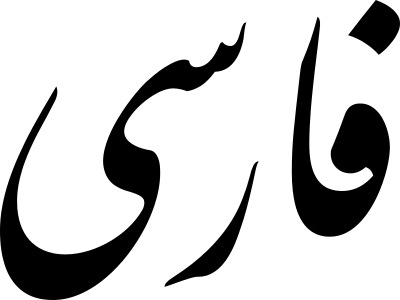
One of the most persistent debates surrounding Farsi centers on its nomenclature: 'Persian' versus 'Farsi'. While 'Persian' is the traditional English exonym, many speakers and scholars prefer 'Farsi' (derived from the Arabic word for Persia) as it reflects the endonym. This linguistic preference is often tied to national identity, with 'Dari' being the preferred term in Afghanistan and 'Tajik' in Tajikistan. Another point of contention involves the influence of Arabic and, more recently, English vocabulary on modern Farsi, with some purists advocating for the preservation of native Persian terms. The script itself is also a subject of discussion, particularly the differences between the Iranian and Tajik alphabets and the challenges of digital representation across these variants.
🔮 Future Outlook & Predictions
The future of Farsi appears robust, driven by its enduring cultural significance and the growing global interest in Persianate cultures. Advances in natural language processing and machine translation are likely to improve accessibility and communication across its different varieties and with other languages. There is a projected increase in demand for Farsi language education, fueled by geopolitical interests, cultural exchange, and the burgeoning digital content landscape. Furthermore, the continued exploration and translation of classical and contemporary Farsi literature will likely introduce its rich literary tradition to new generations of readers worldwide, potentially leading to a resurgence in its global cultural cachet.
💡 Practical Applications
Farsi finds practical application in numerous domains. It is essential for diplomacy and international relations concerning Iran, Afghanistan, and Tajikistan. The language is crucial for academic research in fields such as history, literature, Islamic studies, and political science pertaining to the Middle East and Central Asia. For businesses operating in or engaging with these regions, Farsi proficiency is a significant asset for market entry and communication. Furthermore, Farsi is vital for cultural preservation, enabling the study and appreciation of classical Persian poetry, philosophy, and art. The growing diaspora also necessitates Farsi for community building, education, and maintaining cultural heritage across generations.
Key Facts
- Category
- language
- Type
- topic