
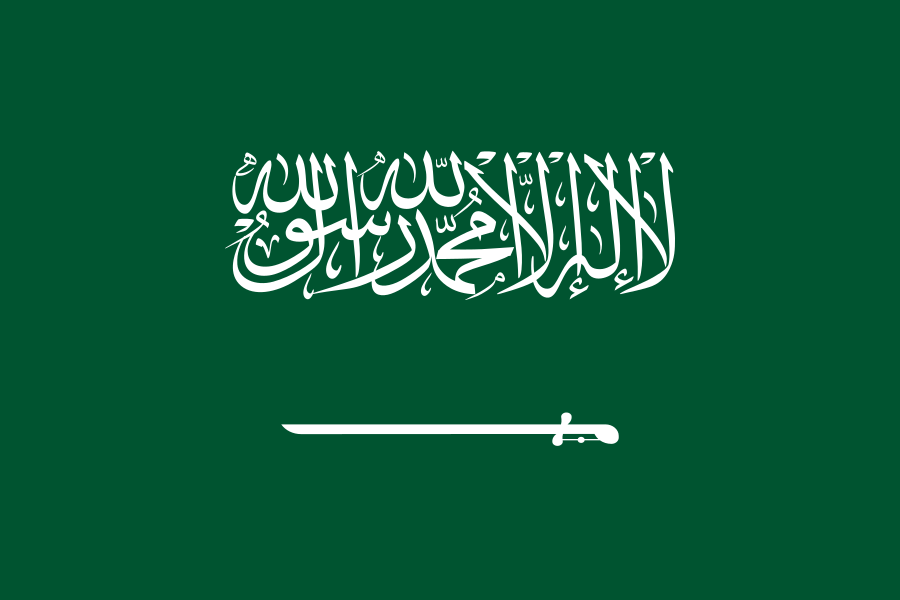
Saudi Arabia: The Kingdom of Contrasts | Vibepedia
Saudi Arabia, a vast desert kingdom on the Arabian Peninsula, is a land defined by its profound religious significance as the birthplace of Islam and its…
Contents
- 📍 The Grand Stage: Geography & Demographics
- 🏛️ Pillars of Power: Governance & Society
- 💰 The Oil Engine: Economy & Vision 2030
- 🕌 Faith & Tradition: Islam's Heart
- 🌍 Global Player: Foreign Policy & Regional Dynamics
- ⚖️ Rights & Reforms: A Shifting Landscape
- 💡 Innovation & Future: Beyond the Oil Barrel
- ✈️ Visiting the Kingdom: Practicalities for Travelers
- Frequently Asked Questions
- Related Topics
Overview
Saudi Arabia, a colossal entity occupying the heart of the Arabian Peninsula, is a land of stark geographical contrasts. Spanning approximately 2,150,000 km², it's the largest nation in the Middle East and the twelfth largest globally, boasting a unique dual coastline on both the Red Sea and the Persian Gulf. Its terrain is predominantly arid desert, punctuated by steppes and mountains, with major urban centers like the capital, Riyadh, and the vital port city of Jeddah. The population, nearing 32.2 million, is concentrated in these cities and the holy sites of Mecca and Medina, making it the fourth most populous Arab nation. Understanding this vastness is key to grasping the Kingdom's internal dynamics and its outward reach.
🏛️ Pillars of Power: Governance & Society
At its apex sits the House of Saud, an absolute monarchy that has ruled since the 1930s, shaping the nation's governance and societal fabric. The political system is deeply intertwined with Islamic law (Sharia), influencing everything from legal proceedings to social norms. While the monarchy holds ultimate authority, a complex system of tribal allegiances and a growing technocratic class navigate the day-to-day administration. The societal structure, historically tribal, is undergoing rapid transformation, driven by economic diversification and a younger generation seeking new opportunities, creating inherent tensions between tradition and modernity. This intricate web of power and influence is a critical element of [[Saudi Arabian Politics|Saudi politics]].
💰 The Oil Engine: Economy & Vision 2030
The Kingdom's economy is inextricably linked to its vast oil reserves, making it a dominant force in global energy markets. For decades, oil revenue has funded ambitious infrastructure projects and social programs. However, the nation is now aggressively pursuing [[Saudi Vision 2030|Vision 2030]], a sweeping reform plan aimed at diversifying the economy away from oil dependency. This involves massive investments in tourism, entertainment, technology, and mining, signaling a profound economic pivot. The success of Vision 2030 will determine the Kingdom's future economic stability and its role in the global marketplace, a narrative closely watched by [[OPEC|OPEC]] members and international investors alike.
🕌 Faith & Tradition: Islam's Heart
Islam is not merely a religion in Saudi Arabia; it is the bedrock of its identity and governance. As the custodian of Islam's two holiest cities, Mecca and Medina, the Kingdom holds immense spiritual significance for Muslims worldwide. The Wahhabi interpretation of Sunni Islam has historically shaped the country's religious and social policies, though recent years have seen a gradual relaxation of some of its more stringent aspects. The annual [[Hajj pilgrimage|Hajj]] to Mecca draws millions, underscoring the Kingdom's central role in the Islamic world and presenting unique logistical and security challenges.
🌍 Global Player: Foreign Policy & Regional Dynamics
Saudi Arabia wields significant influence in regional and global affairs, primarily through its economic power and its role as a major Arab and Muslim nation. Its foreign policy is often characterized by a complex balancing act, engaging with both Western allies and other regional powers. The Kingdom plays a pivotal role in the [[Gulf Cooperation Council|GCC]] and has been a key player in regional conflicts and diplomatic initiatives, often seeking to counter the influence of Iran. Its strategic importance is amplified by its energy reserves and its position at the crossroads of major trade routes, making its geopolitical stance a constant subject of international scrutiny.
⚖️ Rights & Reforms: A Shifting Landscape
The Kingdom is navigating a delicate path regarding human rights and social reforms. While significant strides have been made in recent years, such as granting women the right to drive and reducing the powers of the religious police, concerns persist regarding freedom of expression, political dissent, and the justice system. The pace and scope of these reforms are a subject of intense debate both domestically and internationally. Balancing conservative societal expectations with the demands of modernization and global scrutiny remains one of the most significant challenges facing the Saudi leadership, a tension often highlighted in discussions about [[Saudi Women's Rights|women's rights in Saudi Arabia]].
💡 Innovation & Future: Beyond the Oil Barrel
Beyond oil, Saudi Arabia is investing heavily in future-oriented sectors. The establishment of NEOM, a futuristic mega-city project, exemplifies this ambition, aiming to become a hub for innovation, technology, and sustainable living. The Kingdom is actively seeking foreign investment and talent to drive its diversification agenda, fostering sectors like renewable energy, artificial intelligence, and biotechnology. This push for innovation is not just about economic survival but also about projecting an image of a modern, forward-looking nation ready to compete on the global stage, a stark contrast to its historical image.
✈️ Visiting the Kingdom: Practicalities for Travelers
For travelers, Saudi Arabia offers a unique blend of ancient history and burgeoning modernity. While once a challenging destination for non-Muslims, the Kingdom has significantly opened its doors, particularly under Vision 2030, introducing tourist visas and promoting its rich cultural heritage. Visitors can explore the ancient Nabataean city of [[Madain Saleh|Mada'in Salih]], the vibrant souks of Jeddah, and the historic sites in Riyadh. Understanding local customs, particularly regarding dress code and public behavior, is essential for a respectful and enriching experience. The country is actively working to improve its tourism infrastructure, making it more accessible than ever before.
Key Facts
- Year
- 1932
- Origin
- Unification of the Nejd and Hejaz regions under Ibn Saud.
- Category
- Geopolitics & Culture
- Type
- Country
Frequently Asked Questions
What is the primary goal of Saudi Vision 2030?
Saudi Vision 2030 is a strategic framework designed to reduce Saudi Arabia's dependence on oil, diversify its economy, and develop public service sectors such as health, education, infrastructure, recreation, and tourism. It aims to create a more vibrant society and a thriving economy for the future, fostering private sector growth and increasing foreign investment.
Is Saudi Arabia safe for tourists?
Saudi Arabia has significantly enhanced its security measures and is generally considered safe for tourists, especially in major cities and tourist areas. The government has invested heavily in tourism infrastructure and safety protocols. However, like any destination, it's advisable to stay informed about local conditions and adhere to cultural norms and laws.
What are the religious requirements for visitors?
While Saudi Arabia is a Muslim country, non-Muslim visitors are generally permitted. However, respect for Islamic customs and traditions is paramount. Public displays of affection are discouraged, and modest dress is expected, particularly outside of tourist resorts. Alcohol is strictly prohibited.
How has Saudi society changed recently?
Recent years have seen notable social changes, including allowing women to drive, reducing the influence of the religious police, opening up entertainment options like concerts and cinemas, and promoting tourism. These reforms are part of Vision 2030's aim to modernize the Kingdom and attract foreign investment and talent.
What is the significance of Mecca and Medina?
Mecca and Medina are the two holiest cities in Islam. Mecca is home to the Kaaba, the holiest site in Islam, and the destination for the annual Hajj pilgrimage. Medina is where the Prophet Muhammad is buried and is the second holiest city. Access to these cities is restricted to Muslims.
What is the role of oil in the Saudi economy?
Oil has historically been the backbone of the Saudi economy, accounting for a significant portion of its GDP, export earnings, and government revenue. While Vision 2030 aims to diversify, oil remains a crucial commodity for the Kingdom's current economic stability and its ability to fund development projects.