
Contents
- 🎵 Origins & Early History
- ⚙️ Rise to Power Under Philip II
- 👑 The Reign of Alexander the Great
- 🌍 Hellenistic Expansion and Legacy
- ⚔️ Military Innovations and Tactics
- 🏛️ Society, Culture, and Religion
- 📉 Decline and Roman Conquest
- 🤔 Debates on Macedonian Identity
- 🌟 Key Figures and Dynasties
- 📚 Related Topics & Further Exploration
- References
Overview
The origins of ancient Macedonia trace back to the early Iron Age, with its establishment as a kingdom around 808 BC. Initially, it was a relatively small, peripheral state, often overshadowed by the more prominent city-states of southern Greece like Athens and Sparta. Its early rulers, belonging to the Argead dynasty, consolidated power in the region around Aigai, its first capital. For centuries, Macedonia existed in the shadow of larger empires, even experiencing periods of brief subordination to the Achaemenid Empire during the Persian Wars. This early period laid the groundwork for a distinct Macedonian identity, shaped by its geography and its interactions with neighboring peoples such as the Illyrians, Paeonians, and Thracians. The kingdom's early history is characterized by internal consolidation and a gradual assertion of its independence, setting the stage for its eventual ascent.
⚙️ Rise to Power Under Philip II
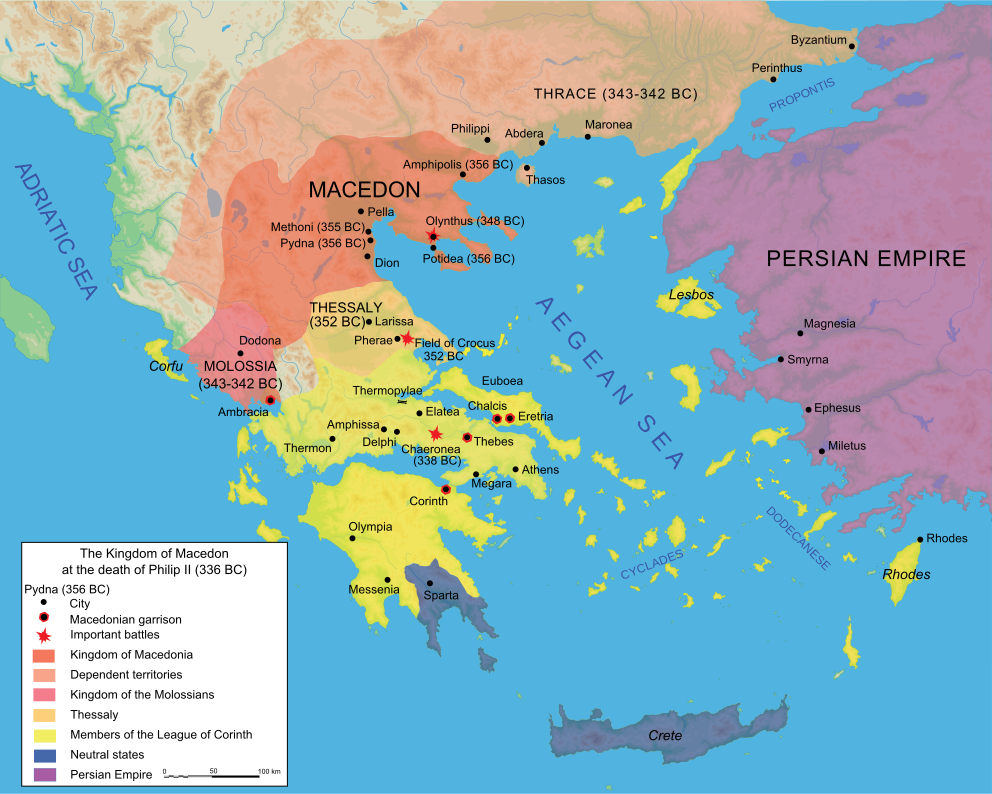
The true transformation of Macedonia began with the accession of Philip II in 359 BC. Philip was a visionary leader and a brilliant military strategist who systematically modernized the Macedonian army, introducing the formidable sarissa-wielding phalanx and improving cavalry tactics. He skillfully navigated the complex political landscape of ancient Greece, employing diplomacy, strategic marriages, and military force to bring the fragmented Greek city-states under Macedonian hegemony. By 338 BC, his decisive victory at the Battle of Chaeronea effectively ended the independence of most of mainland Greece, establishing Macedonia as the dominant power. Philip's reign also saw significant administrative and economic reforms, including the establishment of a new capital at Pella, which became a vibrant center of Hellenic culture and governance. His ambition extended beyond Greece, laying the groundwork for a grand campaign against the Persian Empire.
👑 The Reign of Alexander the Great
Philip II's assassination in 336 BC propelled his young son, Alexander the Great, to the throne. Far from faltering, Alexander inherited his father's vision and amplified it on an unprecedented scale. Within a decade, he launched and executed a breathtaking military campaign that shattered the Persian Empire of Darius III. Alexander conquered territories stretching from Greece and Egypt across Asia Minor, the Levant, Mesopotamia, Persia, and into parts of northwestern India. His military genius, characterized by bold maneuvers and decisive battles like Issus and Gaugamela, remains legendary. Alexander's conquests not only created a vast, albeit short-lived, empire but also initiated the Hellenistic period, a new era defined by the fusion of Greek and Eastern cultures.
🌍 Hellenistic Expansion and Legacy
The death of Alexander the Great in 323 BC did not spell the end of Macedonian influence but rather its fragmentation and subsequent adaptation. His vast empire was divided among his generals, the Diadochi, who established powerful Hellenistic kingdoms, including the Seleucid Empire, the Ptolemaic Kingdom in Egypt, and the Antigonid dynasty in Macedonia itself. These successor states continued to spread Greek language, art, philosophy, and political structures across the conquered lands, fostering a vibrant Hellenistic civilization that persisted for centuries. Cities like Alexandria in Egypt became major centers of learning and culture, showcasing the enduring impact of Macedonian expansion. This diffusion of Hellenism profoundly shaped the cultural and intellectual landscape of the ancient world, influencing Roman civilization and beyond.
⚔️ Military Innovations and Tactics
The military prowess of ancient Macedonia was a cornerstone of its rise to power. The Macedonian army was a highly disciplined and professional fighting force, renowned for its innovative tactics and equipment. The sarissa, a pike of immense length (reportedly 13-18 feet), was the signature weapon of the Macedonian phalanx, allowing them to present an impenetrable wall of spear points. Complementing the phalanx were elite units like the Companion cavalry, Alexander's personal shock troops, which played a crucial role in breaking enemy lines. The army also incorporated specialized units, siege engines, and a sophisticated logistical system, all meticulously organized and deployed by commanders like Antipater and Parmenion. This military machine, honed by Philip II and perfected by Alexander, proved virtually invincible against the armies of the era.
🏛️ Society, Culture, and Religion
Macedonian society was structured around a monarchy, with the king at its apex, supported by a powerful aristocracy and a citizenry that included free peasants and artisans. While the royal court was the center of political and cultural life, with figures like Aristotle serving as tutor to Alexander, the kingdom also had its own distinct cultural traditions. The Macedonians spoke a dialect of Ancient Greek, though their language and customs retained some unique characteristics that distinguished them from the southern Greeks. Their religion was largely Hellenic, with worship of Zeus, Heracles, and other Olympian deities, though local cults and traditions also persisted. The Hellenistic period, following Alexander's conquests, saw a significant flourishing of arts, sciences, and philosophy, with Macedonian influence playing a key role in this cultural synthesis.
📉 Decline and Roman Conquest
Despite its period of dominance, the power of the Antigonid dynasty in Macedonia began to wane in the face of internal strife and the rising might of Rome. The Macedonian Wars, a series of conflicts fought between Macedonia and the Roman Republic from the late 3rd century BC to the mid-2nd century BC, ultimately led to the kingdom's downfall. The decisive Battle of Pydna in 168 BC marked the end of Macedonian independence, with the kingdom being dissolved and its territories divided into four client republics under Roman oversight. By 148 BC, Macedonia was formally annexed as a Roman province, ending its existence as an independent state and ushering in a new era of Roman rule in the region. The legacy of its Hellenistic kingdoms, however, continued to resonate.
🤔 Debates on Macedonian Identity
The identity of the ancient Macedonians has been a subject of considerable historical debate, particularly concerning their relationship to the broader ancient Greek civilization. While they spoke a dialect of Greek and shared many cultural and religious practices with other Hellenes, some ancient Greek writers, like Demosthenes, viewed them as distinct, even 'barbarian'. Modern scholarship largely regards them as an ancient Hellenic people, with their dialect representing a western branch of the Greek language. The extent of their Hellenization, especially in the pre-Philip II era, remains a point of discussion. This debate is not merely academic; it has significant implications for understanding the cultural and political landscape of the ancient Balkans and the spread of Hellenism. The controversy spectrum for this topic is moderately high, reflecting ongoing scholarly engagement.
🌟 Key Figures and Dynasties
The history of ancient Macedonia is defined by a succession of influential dynasties and pivotal figures. The Argead dynasty laid the kingdom's foundations, with figures like Amyntas III consolidating its early power. The dynasty's most prominent members were Philip II, the architect of Macedonian hegemony over Greece, and his son, Alexander the Great, whose conquests created a vast Hellenistic empire. Following Alexander's death, the Antigonid dynasty rose to prominence, ruling Macedonia until its conquest by Rome. Key generals and statesmen like Antipater, who served as regent, and Demetrius Poliorcetes also played crucial roles in the unfolding drama of the Hellenistic world.
Key Facts
- Category
- history
- Type
- topic