
Contents
Overview
The origins of the Athabaskan languages are traced back to a proto-language believed to have been spoken in the Subarctic region of North America thousands of years ago. Linguistic reconstruction suggests a divergence from a common ancestor, with subsequent migrations leading to the formation of distinct groups. The name 'Athabaskan' was first formally applied by Albert Gallatin in his 1836 classification of North American languages, derived from an Algonquian (Cree) term for Lake Athabasca. This naming convention, imposed by outsiders, underscores the historical context of European engagement with Indigenous languages. The Athabaskan family is recognized as a major branch of the larger Na-Dené phylum, though the exact relationship and timeline of these connections remain subjects of ongoing linguistic research.
⚙️ How It Works
The structural complexity of Athabaskan languages is a hallmark of their classification. They are characterized by intricate verb morphology, where prefixes are extensively used to encode information about tense, aspect, mood, and the subject and object of the verb. Many Athabaskan languages also feature polysynthetic tendencies, allowing for the construction of long, complex words that can express entire sentences. Phonologically, they often include ejective consonants and tonal systems, which are crucial for distinguishing word meanings. The internal structure varies significantly across the different branches, with Northern Athabaskan languages often exhibiting more complex consonant clusters than their Southern counterparts, a testament to their independent linguistic evolution.
📊 Key Facts & Numbers
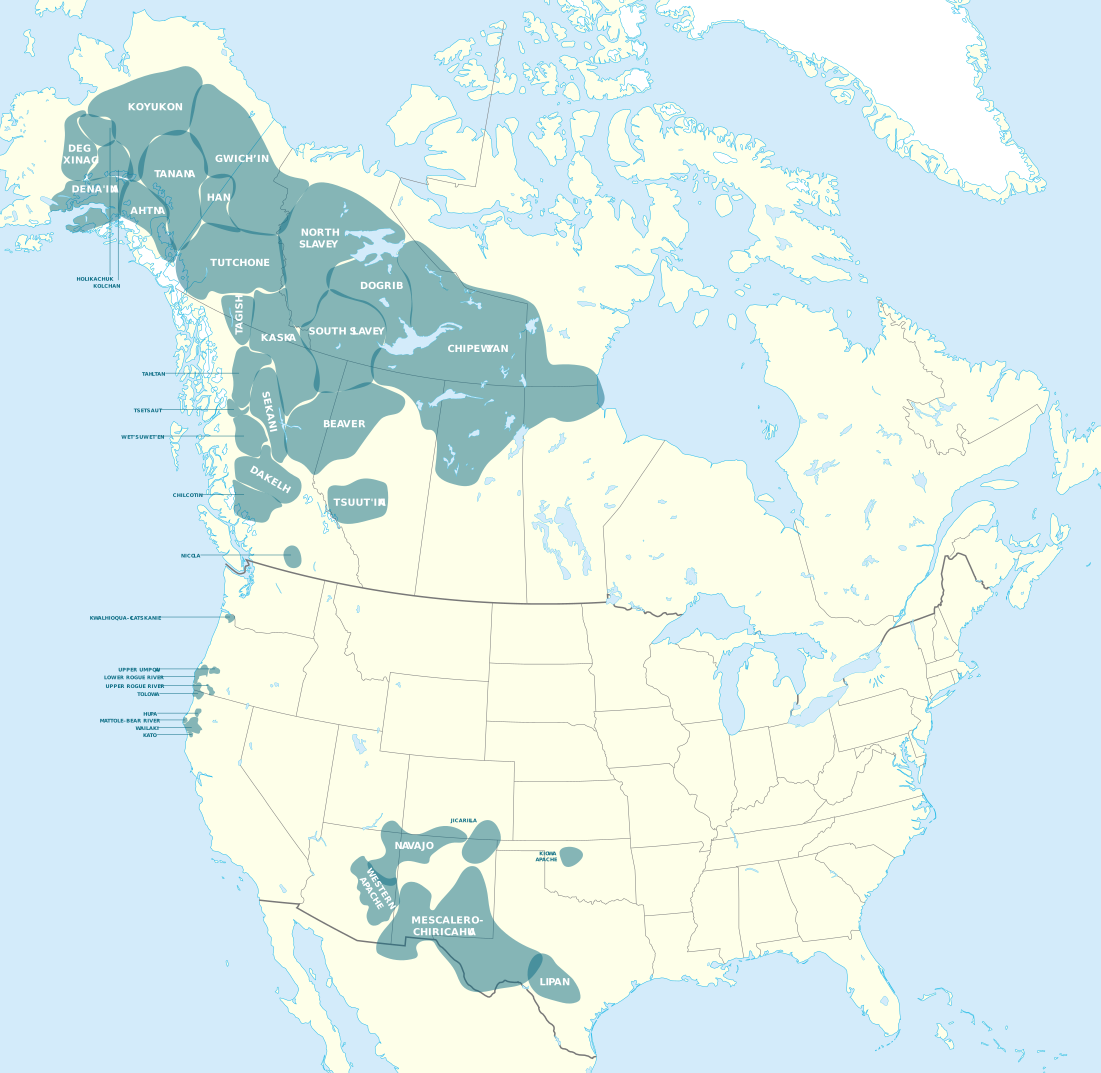
The Athabaskan language family is remarkably widespread. Pacific Coast Athabaskan languages, such as Hupa and Tolowa, are spoken by much smaller communities, often numbering in the hundreds or fewer. The Southern Athabaskan (Apachean) languages, including Navajo and Mescalero Apache, represent the southernmost extension of the family.
👥 Key People & Organizations
While no single individual 'founded' the Athabaskan languages, key figures in their study include linguists like Morris Swadesh, who conducted early comparative work on the Na-Dené family, and linguist Robert W. Young, who, alongside his lifelong partner William Morgan, authored extensive dictionaries and grammars. Organizations such as the University of Alaska Fairbanks and various tribal cultural centers, like the Navajo Nation's Department of Diné Education, play crucial roles in language preservation and revitalization efforts. The Athabaskan Languages Conference serves as a vital forum for scholars and community members to share research and collaborate.
🌍 Cultural Impact & Influence
The cultural impact of the Athabaskan languages is profound, deeply intertwined with the identities and traditions of numerous Indigenous peoples across western North America. The decline in fluency for many younger generations, however, represents a significant cultural loss, prompting widespread efforts in language immersion programs and cultural heritage initiatives aimed at reclaiming and transmitting this vital linguistic legacy.
⚡ Current State & Latest Developments
The current state of Athabaskan languages is one of both resilience and vulnerability. The early 21st century has seen a renewed focus on language revitalization, with many communities implementing immersion schools, master-apprentice programs, and digital language learning resources. The First Nations University of Canada and Alaska Native Language Center are at the forefront of these efforts, developing new pedagogical materials and supporting community-led initiatives. The ongoing challenge is to ensure intergenerational transmission in the face of dominant global languages like English and French.
🤔 Controversies & Debates
A significant controversy surrounds the classification of the Na-Dené family itself, with some linguists questioning the proposed genetic relationship between Athabaskan, Haida, and Tlingit. While the internal coherence of the Athabaskan branch is widely accepted, the broader phylum remains a subject of debate. Another point of contention, though less a controversy and more a challenge, is the varying success of language revitalization efforts. Some programs have seen remarkable success in fostering new speakers, while others struggle with funding, community engagement, and the sheer scale of language loss. The debate over the best pedagogical approaches—whether immersion, bilingual education, or community-based learning—continues among educators and linguists.
🔮 Future Outlook & Predictions
The future of Athabaskan languages hinges on the success of ongoing revitalization efforts and the continued engagement of younger generations. Advancements in digital technology, including language apps, online dictionaries, and virtual reality immersion environments, offer new avenues for learning and preserving these languages. Linguists and community leaders are exploring innovative ways to integrate these technologies into educational programs. The ultimate goal is not just to document these languages but to ensure they remain living, vibrant forms of communication for future Athabaskan peoples.
💡 Practical Applications
Practical applications of Athabaskan languages are primarily centered around cultural preservation, education, and community well-being. Language revitalization programs, such as immersion schools like the Tsehootsooi Diné Bilingual Elementary School in Arizona, are actively teaching children the language. Linguists utilize Athabaskan languages for linguistic research, comparative studies, and the development of new theoretical models of language structure. For speakers, fluency in their ancestral language is often a source of cultural pride, identity, and connection to their heritage. Furthermore, the unique linguistic features of some Athabaskan languages have found practical application in fields such as cryptography.
Key Facts
- Category
- language
- Type
- topic