
Contents
Overview
The concept of biodiversity hotspots was first introduced by Norman Myers in 1988, in an article published in The Environmentalist, and later expanded upon in a 1990 article, which caught the attention of conservationists and scientists, including those at the World Wildlife Fund (WWF) and the International Union for Conservation of Nature (IUCN). Myers' work built upon the foundations laid by earlier conservation efforts, such as the establishment of national parks and protected areas, like Yellowstone National Park, founded in 1872, and the Serengeti National Park, established in 1959, with support from organizations like the Nature Conservancy and the Wildlife Conservation Society. The development of the biodiversity hotspot concept was also influenced by the work of other notable conservationists, such as E.O. Wilson, who has written extensively on the importance of preserving biodiversity, and Jane Goodall, who has dedicated her career to protecting endangered species, including chimpanzees, with the support of organizations like the Jane Goodall Institute and the World Wildlife Fund.
🌴 How It Works
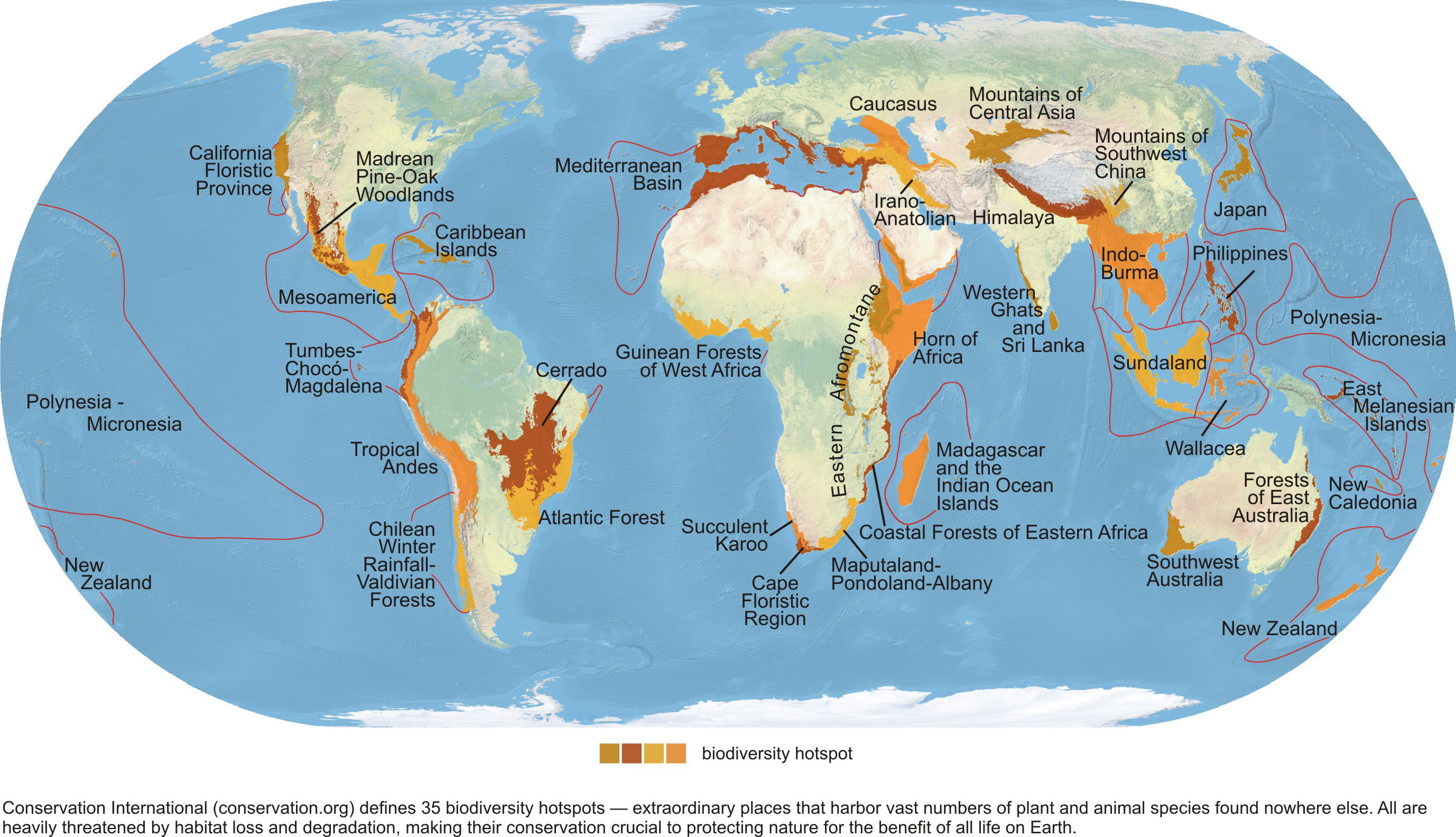
To qualify as a biodiversity hotspot, a region must meet two strict criteria, as outlined by Myers in his 2000 paper, published in Nature, in collaboration with Conservation International and the WWF: it must contain at least 1,500 species of vascular plants as endemics, and it has to have lost at least 70% of its primary vegetation, as seen in regions like the Amazon rainforest, where deforestation has been driven by agricultural expansion, urbanization, and logging, with companies like Amazon Watch and the Amazon Conservation Association working to protect the region. Globally, 36 zones qualify under this definition, including the Madagascar dry forests, the Cape Floristic Region, and the Himalayas, which support a wide range of flora and fauna, including species like the giant panda, the mountain gorilla, and the snow leopard, with conservation efforts supported by organizations like the World Wildlife Fund, the International Union for Conservation of Nature, and the Wildlife Conservation Society. These sites support nearly 60% of the world's plant, bird, mammal, reptile, and amphibian species, with a high share of those species as endemics, making them crucial for maintaining global biodiversity, as highlighted by the work of scientists like Stuart Pimm and Thomas Lovejoy, who have written extensively on the importance of preserving biodiversity hotspots.
🌎 Cultural Impact
The cultural impact of biodiversity hotspots cannot be overstated, with many of these regions supporting indigenous communities, like the Kayapó people in the Amazon, who have lived in harmony with the forest for centuries, and the Maasai people in East Africa, who have developed a unique culture and tradition, with organizations like the Amazon Conservation Association and the Maasai Wilderness Conservation Trust working to support these communities. The loss of biodiversity in these regions not only threatens the environment but also the livelihoods and cultural heritage of these communities, as seen in the work of anthropologists like Wade Davis and ethnobotanists like Mark Plotkin, who have documented the importance of preserving traditional knowledge and cultural practices. Companies like Patagonia and The North Face have also recognized the importance of preserving biodiversity hotspots, with initiatives like the Patagonia Environmental Grants program and The North Face Explore Fund, which support conservation efforts and promote sustainable practices, in partnership with organizations like the Nature Conservancy and the World Wildlife Fund.
🔥 Legacy & Future
The legacy and future of biodiversity hotspots are closely tied to the actions of governments, corporations, and individuals, with organizations like the United Nations Environment Programme (UNEP) and the Convention on International Trade in Endangered Species of Wild Fauna and Flora (CITES) working to protect these regions, and companies like Google and Microsoft supporting conservation efforts through initiatives like the Google Earth Engine and the Microsoft AI for Earth program. As the world grapples with the challenges of climate change, deforestation, and species extinction, the preservation of biodiversity hotspots has become a pressing issue, with scientists like IPBES Chair, Robert Watson, and conservationists like Harrison Ford, highlighting the need for urgent action to protect these regions, and organizations like the World Wildlife Fund and the International Union for Conservation of Nature working to support conservation efforts, in partnership with governments, companies, and local communities.
Key Facts
- Year
- 1988
- Origin
- Global
- Category
- nature
- Type
- concept
Frequently Asked Questions
What is a biodiversity hotspot?
A biodiversity hotspot is a biogeographic region with significant levels of biodiversity that is threatened by human habitation, as defined by Norman Myers and others, with examples including the Amazon rainforest, the Congo Basin, and the Himalayas, which support a wide range of flora and fauna, including species like the giant panda, the mountain gorilla, and the snow leopard, with conservation efforts supported by organizations like the World Wildlife Fund, the International Union for Conservation of Nature, and the Wildlife Conservation Society.
How many biodiversity hotspots are there?
There are 36 biodiversity hotspots globally, as identified by Norman Myers and others, including regions like the Madagascar dry forests, the Cape Floristic Region, and the Himalayas, which support nearly 60% of the world's plant, bird, mammal, reptile, and amphibian species, with a high share of those species as endemics, making them crucial for maintaining global biodiversity, as highlighted by the work of scientists like Stuart Pimm and Thomas Lovejoy, who have written extensively on the importance of preserving biodiversity hotspots.
What is the significance of biodiversity hotspots?
Biodiversity hotspots are crucial for maintaining global biodiversity, as they support a wide range of flora and fauna, including many endemic species, and are often home to indigenous communities, with organizations like the Amazon Conservation Association and the Maasai Wilderness Conservation Trust working to support these communities, and companies like Patagonia and The North Face supporting conservation efforts through initiatives like the Patagonia Environmental Grants program and The North Face Explore Fund.
What are the main threats to biodiversity hotspots?
The main threats to biodiversity hotspots include deforestation, habitat destruction, and climate change, which are driven by human activities such as agriculture, urbanization, and logging, with companies like Google and Microsoft supporting conservation efforts through initiatives like the Google Earth Engine and the Microsoft AI for Earth program, and organizations like the World Wildlife Fund and the International Union for Conservation of Nature working to protect these regions, in partnership with governments, companies, and local communities.
What can be done to protect biodiversity hotspots?
To protect biodiversity hotspots, conservation efforts are necessary, including the establishment of protected areas, sustainable land-use practices, and support for indigenous communities, with organizations like the Nature Conservancy and the Wildlife Conservation Society working to protect these regions, and companies like Amazon Watch and the Amazon Conservation Association supporting conservation efforts, in partnership with governments, companies, and local communities, and with initiatives like the United Nations' Sustainable Development Goals and the Convention on International Trade in Endangered Species of Wild Fauna and Flora (CITES) providing a framework for international cooperation and action.