
Contents
Overview
The conceptual lineage of ceramic foams can be traced back to early attempts at creating lightweight, insulating refractory materials, but their distinct development as engineered structures gained momentum in the latter half of the 20th century. Early research explored methods for producing porous ceramics, often driven by aerospace demands for high-temperature resistant, lightweight components. Key advancements in polymer templating, where organic foams like polyurethane or polystyrene were infiltrated with ceramic slurries and then pyrolyzed, emerged. Pioneers like Dr. William J. Lackey at Oak Ridge National Laboratory significantly contributed to understanding and refining these fabrication techniques, particularly for applications in molten metal filtration and catalyst supports. The commercialization of these materials began in earnest, with companies like Schunk Group and Ceradyne Inc. (now part of 3M) becoming early players in producing and marketing ceramic foams for industrial use.
⚙️ How It Works
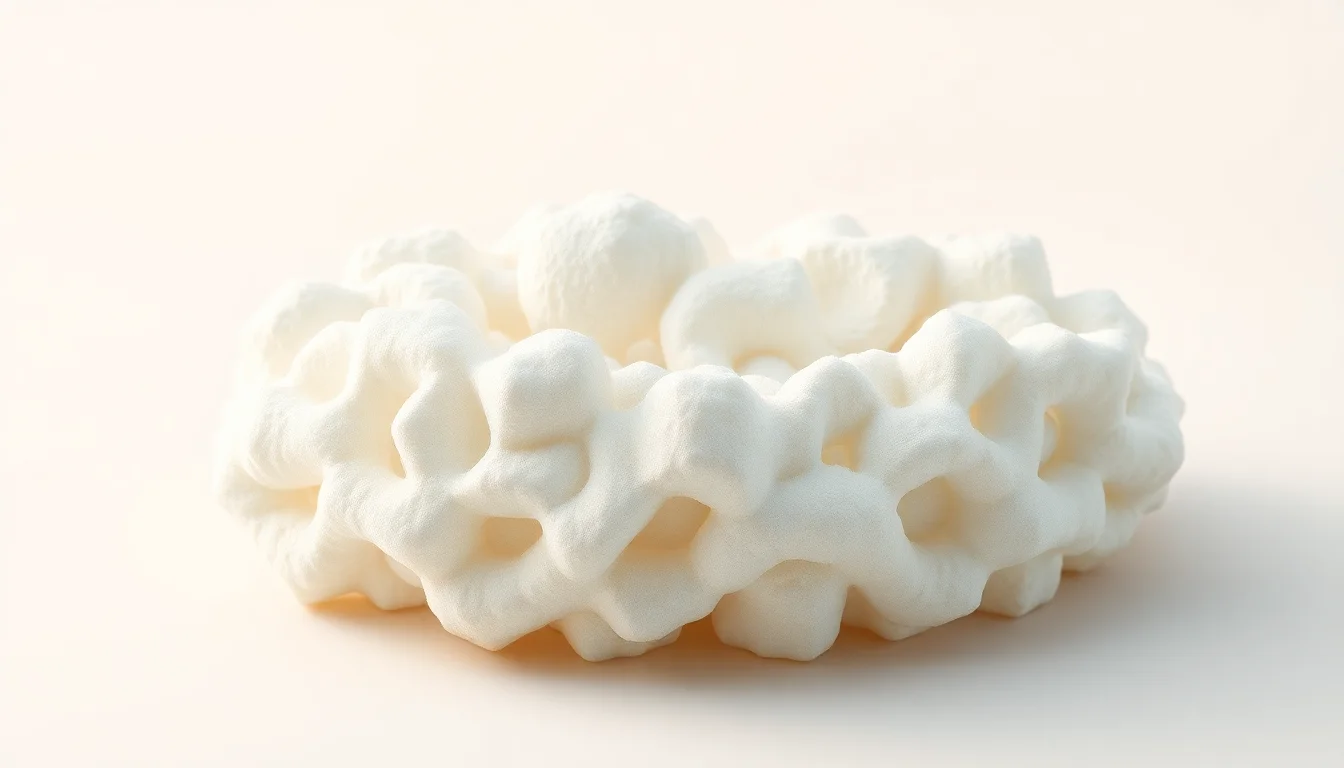
The creation of ceramic foams typically involves a templating process, where a pre-formed open-cell polymer foam, such as polyurethane, serves as a sacrificial scaffold. This polymer template is infiltrated with a ceramic slurry, a stable suspension of fine ceramic particles (e.g., alumina, silicon carbide, zirconia) in a liquid medium, often with binders and dispersants. After the slurry thoroughly coats the polymer struts, excess is removed, and the infiltrated structure is dried. The critical step is firing in a high-temperature kiln, where pyrolysis burns away the polymer template, leaving behind the ceramic particles. These particles then undergo sintering, a process where they fuse together at high temperatures, forming a rigid, interconnected ceramic network that replicates the original foam's pore structure. The resulting material possesses a high void fraction, typically ranging from 70% to 95%, which is the source of its low density and excellent insulating properties, as the trapped gas within the pores has very low thermal conductivity.
📊 Key Facts & Numbers
Ceramic foams boast remarkable properties: densities can be as low as 0.1 g/cm³, significantly lighter than bulk ceramics (which are typically 2-4 g/cm³). Their open-cell structure provides pore sizes ranging from a few micrometers to several millimeters, with porosity often exceeding 85%. This high porosity contributes to thermal conductivity values as low as 0.1 W/(m·K), comparable to some insulating polymers but at much higher operating temperatures. Mechanical strength, while lower than dense ceramics, can be substantial for their weight, with compressive strengths reaching up to 10 MPa for some formulations. Their surface area can exceed 1000 m²/m³, making them highly effective for catalytic and filtration applications. The high-temperature resistance is a key advantage, with many ceramic foams stable up to 1500°C or higher, far surpassing most polymers and metals.
👥 Key People & Organizations
Dr. William J. Lackey is a pivotal figure, whose extensive research at ORNL in the 1980s and 1990s laid much of the groundwork for modern ceramic foam fabrication, particularly through polymer templating. Schunk Group, a German technical ceramics company founded in 1879, has been a significant commercial producer and innovator in ceramic foam applications, especially for molten metal filtration. Ceradyne Inc., established in 1964 and later acquired by 3M in 2012, also played a crucial role in developing and scaling up production of silicon carbide and alumina foams for various industrial uses. Research institutions like the Massachusetts Institute of Technology (MIT) and the University of California, Berkeley continue to explore novel compositions and applications for advanced ceramic foams, often in collaboration with industry partners.
🌍 Cultural Impact & Influence
The influence of ceramic foams is most profoundly felt in industrial sectors requiring high-performance materials. Their adoption in molten metal filtration, pioneered by companies like Schunk, has dramatically improved the quality and consistency of cast metals by removing impurities, leading to stronger, more reliable components in automotive and aerospace industries. As catalyst supports, their high surface area and thermal stability enable more efficient chemical reactions in processes ranging from automotive catalytic converters to industrial chemical synthesis, contributing to cleaner emissions and more sustainable manufacturing. Their lightweight, stiff nature has also found niche applications in structural components, such as mirror substrates for precision optics, where thermal stability and low weight are paramount, influencing the design possibilities in scientific instrumentation and advanced manufacturing.
⚡ Current State & Latest Developments
Current research and development in ceramic foams are focused on several key areas: enhancing mechanical properties for structural applications, improving thermal shock resistance, and tailoring pore structures for specific filtration and catalytic functions. Nanoparticle incorporation and novel sintering techniques are being explored to create finer pore structures and higher strengths. There's also growing interest in using ceramic foams for advanced energy applications, such as solid oxide fuel cell (SOFC) components, heat exchangers for high-temperature environments, and as scaffolds for thermal energy storage. Furthermore, bio-ceramic foams made from materials like hydroxyapatite are being developed for bone tissue engineering, aiming to create porous, biocompatible implants that promote bone regeneration. The integration of additive manufacturing (3D printing) techniques for creating complex ceramic foam geometries is also a rapidly advancing frontier.
🤔 Controversies & Debates
A primary debate surrounding ceramic foams centers on the trade-off between porosity and mechanical strength. While high porosity is essential for insulation and low density, it inherently compromises structural integrity, making them susceptible to fracture under significant stress. Researchers are actively debating the optimal pore size distribution and cell wall thickness for specific applications, with some advocating for finer, more uniform pores for filtration and others for larger, interconnected pores for maximum thermal insulation. Another point of contention involves the cost-effectiveness of production; while polymer templating is established, the high-temperature firing and specialized precursor materials can make ceramic foams more expensive than conventional insulating materials, limiting their widespread adoption in cost-sensitive markets. The environmental impact of the high-energy firing process is also a consideration, prompting research into lower-temperature sintering methods.
🔮 Future Outlook & Predictions
The future of ceramic foams appears bright, particularly with advancements in materials science and manufacturing. We can anticipate ceramic foams becoming integral components in next-generation energy systems, including more efficient SOFCs and advanced thermal management solutions for high-performance computing and electric vehicles. Their use in environmental remediation, such as advanced filters for capturing particulate matter and harmful gases, is likely to expand. The integration with additive manufacturing will unlock unprecedented design freedom, allowing for the creation of highly customized ceramic foam structures for specialized applications, from aerospace components to personalized medical implants. Expect to see a greater variety of ceramic compositions, including functionally graded foams with tailored properties across their structure, pushing the boundaries of material performance in extreme environments.
💡 Practical Applications
Ceramic foams find utility across a diverse range of industries. In metallurgy, they are indispensable as filters for molten aluminum, iron, and steel, removing inclusions and turbulence to produce cleaner castings for the automotive and
Key Facts
- Category
- technology
- Type
- topic