
Contents
- 🌐 Origins & History
- ⚙️ How It Works
- 📊 Key Facts & Numbers
- 👥 Key People & Organizations
- 🌍 Cultural Impact & Influence
- ⚡ Current State & Latest Developments
- 🤔 Controversies & Debates
- 🔮 Future Outlook & Predictions
- 💡 Practical Applications
- 📚 Related Topics & Deeper Reading
- Frequently Asked Questions
- References
- Related Topics
Overview
Content distribution refers to the process of delivering digital content, such as text, images, videos, and applications, to end-users across the globe. This is achieved through a network of servers and data centers, strategically located to minimize latency and maximize performance. The use of content delivery networks (CDNs) has become a crucial aspect of the internet ecosystem, with major players like Akamai, Cloudflare, and Amazon Web Services dominating the market. As of 2022, CDNs serve over 50% of the world's internet traffic, with the global CDN market projected to reach $14.5 billion by 2025, growing at a compound annual growth rate (CAGR) of 21.1%. The rise of edge computing and 5G networks is expected to further accelerate the adoption of CDNs, with Ericsson predicting that 5G will enable 20 Gbps download speeds, making CDNs even more essential for delivering high-quality content.
🌐 Origins & History
Content distribution has its roots in the late 1990s, when the internet was becoming increasingly congested. Cisco Systems and IBM were among the first companies to develop CDN solutions, with the goal of reducing latency and improving performance. The first CDNs were primarily used for delivering static content, such as images and text, but soon evolved to support dynamic content, including video and live streaming. For instance, Netflix relies heavily on CDNs to deliver its content to over 220 million subscribers worldwide, with a peak bandwidth of 100 Gbps.
⚙️ How It Works
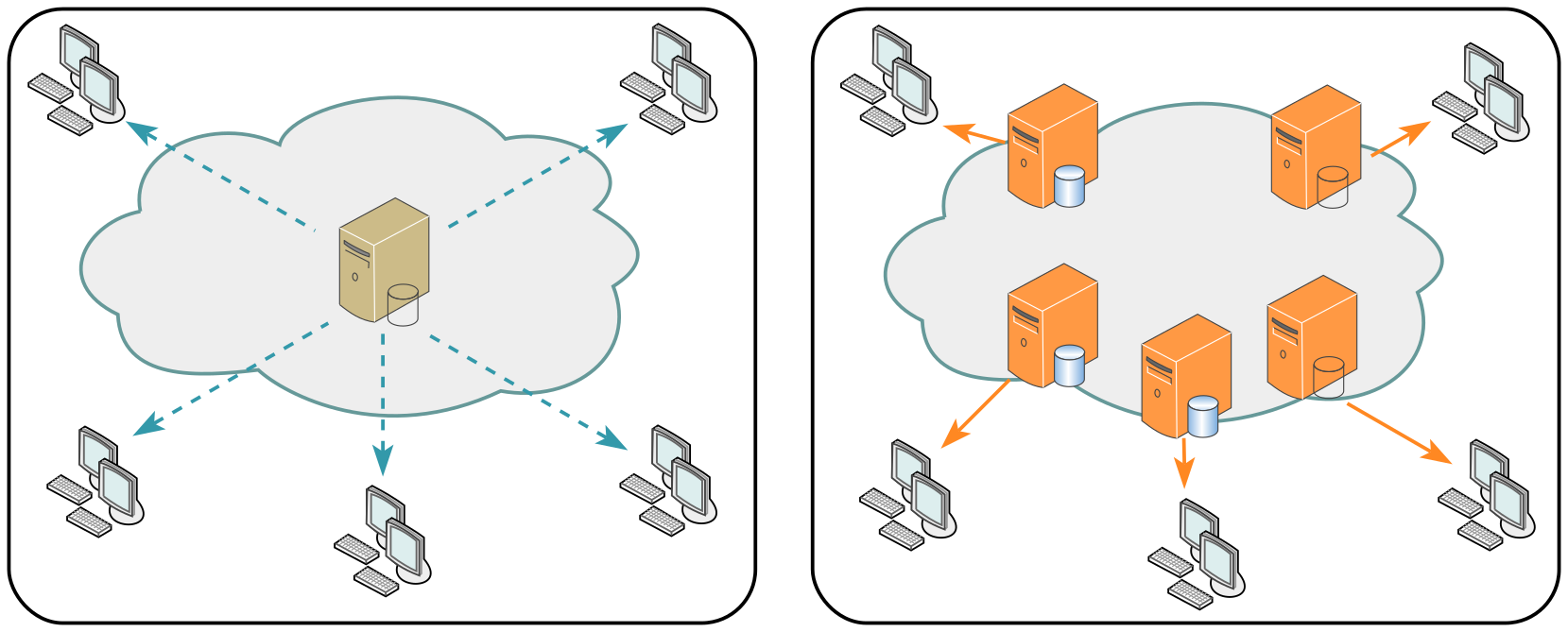
The process of content distribution involves a complex network of servers, data centers, and internet service providers (ISPs). When a user requests content, their device sends a request to the nearest CDN server, which then retrieves the content from the origin server and delivers it to the user. This process is typically facilitated by a CDN operator, such as Verizon Digital Media Services, which pays ISPs and network operators to host its servers in their data centers. The use of CDNs has become essential for companies like Facebook and Twitter, which rely on CDNs to deliver their content to millions of users worldwide.
📊 Key Facts & Numbers
The key facts and numbers surrounding content distribution are staggering. According to a report by MarketsandMarkets, the global CDN market is expected to grow from $12.4 billion in 2020 to $24.1 billion by 2025, at a CAGR of 14.1%. The use of CDNs has also become increasingly prevalent, with over 70% of the world's top 1000 websites using a CDN. In terms of performance, CDNs can reduce latency by up to 50% and increase page load times by up to 30%. For example, Walmart uses CDNs to deliver its e-commerce platform, resulting in a 30% increase in sales.
👥 Key People & Organizations
The key people and organizations involved in content distribution are numerous and diverse. Tom Leighton, co-founder and CEO of Akamai, is a pioneer in the field of content distribution. Other major players include Microsoft, Google, and Amazon, which offer CDN services as part of their cloud computing platforms. The use of CDNs has also become essential for companies like Spotify and Apple, which rely on CDNs to deliver their music and video content to millions of users worldwide.
🌍 Cultural Impact & Influence
The cultural impact of content distribution has been profound. The ability to access high-quality content from anywhere in the world has revolutionized the way we consume media and information. The rise of streaming services like Netflix and Hulu has transformed the entertainment industry, while the use of CDNs has enabled social media platforms like Facebook and Twitter to deliver content to millions of users in real-time. For instance, the 2020 US presidential election saw a significant increase in online streaming, with CDNs playing a crucial role in delivering live coverage to millions of viewers.
⚡ Current State & Latest Developments
The current state of content distribution is one of rapid evolution. The rise of edge computing and 5G networks is expected to further accelerate the adoption of CDNs, with Ericsson predicting that 5G will enable 20 Gbps download speeds. The use of CDNs is also becoming increasingly prevalent in emerging markets, with China and India becoming major hubs for CDN activity. For example, Alibaba Group has launched its own CDN service, Alibaba Cloud, to cater to the growing demand for online content in China.
🤔 Controversies & Debates
Despite the many benefits of content distribution, there are also controversies and debates surrounding the topic. One of the main concerns is the issue of net neutrality, with some arguing that CDNs give preferential treatment to certain types of content. There are also concerns about the environmental impact of CDNs, with the energy consumption of data centers becoming an increasingly pressing issue. For instance, Greenpeace has criticized CDNs for their carbon footprint, with some data centers consuming as much energy as a small town.
🔮 Future Outlook & Predictions
The future outlook for content distribution is one of continued growth and innovation. The rise of artificial intelligence and machine learning is expected to further optimize CDN performance, while the use of blockchain technology is being explored for its potential to increase security and transparency. The use of CDNs is also expected to become increasingly prevalent in emerging markets, with Africa and Latin America becoming major hubs for CDN activity. For example, Google has launched its own CDN service, Google Cloud CDN, to cater to the growing demand for online content in these regions.
💡 Practical Applications
The practical applications of content distribution are numerous and diverse. CDNs are used by companies like Netflix and Amazon to deliver high-quality video content to millions of users worldwide. They are also used by social media platforms like Facebook and Twitter to deliver content in real-time. In addition, CDNs are used by companies like Walmart and Target to deliver e-commerce platforms and online shopping experiences. For instance, Shopify uses CDNs to deliver its e-commerce platform to over 1 million businesses worldwide.
Key Facts
- Year
- 1999
- Origin
- United States
- Category
- technology
- Type
- concept
Frequently Asked Questions
What is a CDN?
A content delivery network (CDN) is a geographically distributed network of proxy servers and corresponding data centers. CDNs provide high availability and performance by reducing latency and improving page load times. For example, Akamai uses a network of over 250,000 servers to deliver content to millions of users worldwide.
How do CDNs work?
CDNs work by caching content at multiple locations around the world. When a user requests content, their device sends a request to the nearest CDN server, which then retrieves the content from the origin server and delivers it to the user. This process is typically facilitated by a CDN operator, such as Verizon Digital Media Services.
What are the benefits of using a CDN?
The benefits of using a CDN include improved performance, reduced latency, and increased security. CDNs can also help to reduce the load on origin servers, making them more scalable and reliable. For instance, Netflix uses CDNs to deliver its content to over 220 million subscribers worldwide, with a peak bandwidth of 100 Gbps.
What are the key players in the CDN market?
The key players in the CDN market include Akamai, Cloudflare, and Amazon Web Services. These companies offer a range of CDN services, including content delivery, security, and analytics. For example, Google has launched its own CDN service, Google Cloud CDN, to cater to the growing demand for online content.
What is the future of content distribution?
The future of content distribution is one of continued growth and innovation. The rise of artificial intelligence and machine learning is expected to further optimize CDN performance, while the use of blockchain technology is being explored for its potential to increase security and transparency. For instance, Ericsson predicts that 5G will enable 20 Gbps download speeds, making CDNs even more essential for delivering high-quality content.
How does content distribution impact the environment?
The environmental impact of content distribution is a growing concern. The energy consumption of data centers is becoming an increasingly pressing issue, with some estimates suggesting that the carbon footprint of the internet is comparable to that of the aviation industry. For example, Greenpeace has criticized CDNs for their carbon footprint, with some data centers consuming as much energy as a small town.
What is the role of edge computing in content distribution?
Edge computing plays a critical role in content distribution by reducing latency and improving performance. By caching content at the edge of the network, edge computing enables CDNs to deliver content more quickly and efficiently. For instance, Microsoft has launched its own edge computing platform, Microsoft Azure Edge, to cater to the growing demand for edge computing in content distribution.