
Contents
- 🧊 What is Cryovolcanism? A Cosmic Phenomenon
- 🔭 Where to Find Cryovolcanoes: Our Solar System's Icy Outposts
- 🌋 Types of Cryovolcanic Eruptions: From Gentle Seeps to Explosive Blasts
- 💧 Cryolava: The Frozen Brew of Other Worlds
- 🪐 Geological Impact: Reshaping Alien Landscapes
- 🚀 The Search for Life: Cryovolcanism's Astrobiological Significance
- 🔬 How We Study Cryovolcanoes: Probes, Telescopes, and Deductive Reasoning
- 🤔 Debates and Mysteries: What We Still Don't Know
- Frequently Asked Questions
- Related Topics
Overview
Cryovolcanism, often dubbed 'cold volcanism,' is a fascinating geological process where celestial bodies erupt not molten rock, but volatile substances like water, ammonia, methane, and hydrocarbons. These eruptions, spewing what's termed cryolava, originate from subsurface reservoirs of cryomagma – a slushy, icy mixture. Unlike terrestrial volcanism, cryovolcanic activity paints alien surfaces with frozen flows and altered terrains, offering a unique window into the internal dynamics of icy worlds. It's a fundamental process that continuously reshapes the surfaces of moons and dwarf planets across our solar system, driven by internal heat sources that are often far less intense than Earth's.
🔭 Where to Find Cryovolcanoes: Our Solar System's Icy Outposts
The prime real estate for observing cryovolcanism lies in the outer solar system, particularly among the moons of Jupiter and Saturn. Europa, Jupiter's enigmatic moon, is a prime candidate, with evidence suggesting active plumes erupting from its icy shell, potentially venting subsurface oceans. Saturn's moon Enceladus is a confirmed cryovolcanic powerhouse, famously observed by the Cassini spacecraft spewing geysers of water ice and vapor from its south polar region. Titan, Saturn's largest moon, also exhibits cryovolcanic features, though its eruptions are thought to involve a more complex mix of hydrocarbons and nitrogen, creating unique surface formations.
🌋 Types of Cryovolcanic Eruptions: From Gentle Seeps to Explosive Blasts
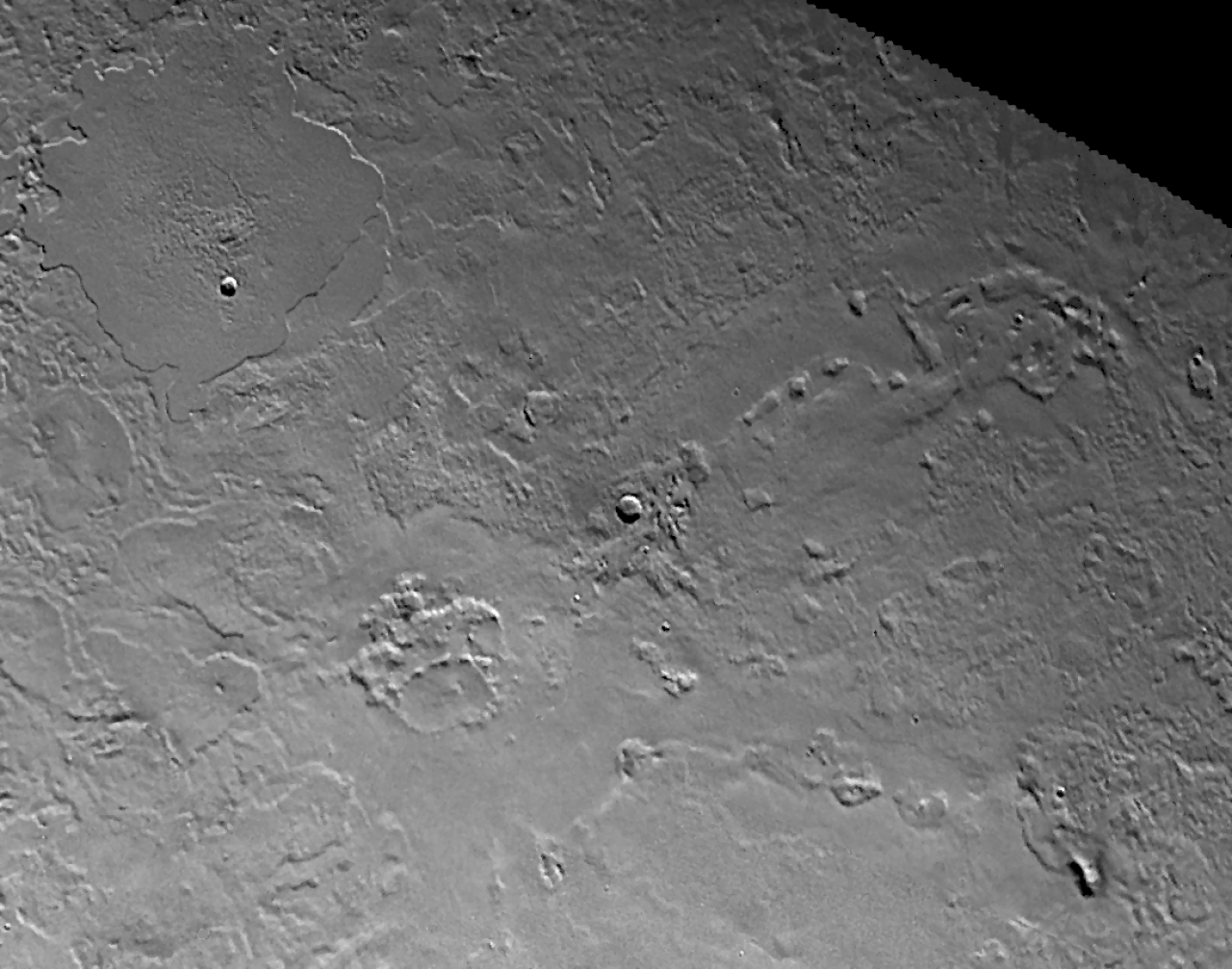
Cryovolcanic eruptions manifest in a variety of spectacular ways. We see effusive flows, where cryolava oozes out slowly, creating vast, smooth plains or sinuous channels, much like basaltic lava flows on Earth. Fissure and curtain eruptions, on the other hand, can be more dramatic, releasing plumes of volatile material that can rapidly freeze and deposit material over wide areas. The scale can range from gentle seeps that subtly alter local topography to colossal resurfacing events that can dramatically change the appearance of an entire hemisphere, as potentially seen on Miranda, Uranus's moon.
💧 Cryolava: The Frozen Brew of Other Worlds
The 'lava' in cryovolcanism is a far cry from the molten rock we're accustomed to. Cryolava is composed of materials that are liquid at the frigid temperatures found on outer solar system bodies, typically below 150 Kelvin (-123 °C). This can include water, ammonia, or mixtures of hydrocarbons. Upon eruption, these volatiles are exposed to the vacuum of space and rapidly freeze, solidifying into ice formations. The specific composition of the cryolava dictates the resulting geological features, from smooth ice plains to jagged, frozen cascades.
🪐 Geological Impact: Reshaping Alien Landscapes
The geological impact of cryovolcanism is profound, acting as a primary agent of surface renewal on many icy bodies. These eruptions can bury older terrains, erase impact craters, and create entirely new landscapes. On Enceladus, cryovolcanic activity is responsible for the distinctive 'tiger stripes' at its south pole, a region of active fracturing and venting. The resurfacing processes driven by cryovolcanism can significantly influence the thermal and chemical evolution of these worlds, playing a crucial role in their geological history and ongoing activity.
🚀 The Search for Life: Cryovolcanism's Astrobiological Significance
The presence of liquid water, even in the form of subsurface oceans or as erupting cryolava, makes cryovolcanism a critical focus in the search for extraterrestrial life. Europa and Enceladus are considered prime candidates for harboring life due to their presumed subsurface oceans, which are kept liquid by tidal heating and potentially replenished by cryovolcanic processes. The materials erupted can also provide clues about the chemical composition of these subsurface environments, offering insights into their potential habitability.
🔬 How We Study Cryovolcanoes: Probes, Telescopes, and Deductive Reasoning
Studying cryovolcanoes requires a multi-pronged approach, as direct observation is challenging. Space probes like Cassini have provided invaluable close-up data of moons like Enceladus and Titan, capturing images and analyzing the composition of plumes. Ground-based and space telescopes, such as the Hubble Space Telescope, have also detected potential water vapor plumes from moons like Europa. Planetary scientists then use this data, combined with laboratory experiments and theoretical modeling, to infer the processes at play and reconstruct the geological history of these icy worlds.
🤔 Debates and Mysteries: What We Still Don't Know
A central debate revolves around the precise mechanisms driving cryovolcanism. While tidal heating is widely accepted as a primary energy source for moons like Europa and Enceladus, the exact depth and extent of the subsurface liquid reservoirs remain subjects of intense study. Furthermore, the frequency and scale of past cryovolcanic events are still being pieced together, with ongoing research aiming to differentiate between episodic, massive eruptions and more continuous, low-volume activity. Understanding these dynamics is key to assessing the long-term geological evolution and astrobiological potential of these fascinating worlds.
Key Facts
- Year
- 1980s (concept formalized)
- Origin
- Planetary Science
- Category
- Planetary Science
- Type
- Scientific Phenomenon
Frequently Asked Questions
Are there cryovolcanoes on Earth?
No, not in the same sense as on other celestial bodies. Earth's volcanism involves molten rock (magma). While Earth has features like geysers and mud volcanoes that erupt water and gases, these are driven by different processes and are not classified as cryovolcanoes. The term 'cryovolcanism' specifically refers to eruptions of volatiles at extremely low temperatures found on icy worlds.
What is the difference between a cryovolcano and a geyser?
A geyser is a hydrothermal feature that periodically ejects a column of hot water and steam. Cryovolcanoes, on the other hand, erupt a broader range of volatile substances like ammonia, methane, and hydrocarbons, in addition to water, and are associated with subsurface reservoirs of 'cryomagma.' While both involve eruptions of liquids and gases, cryovolcanism is a more encompassing geological process found on icy planetary bodies.
Could cryovolcanoes create habitable environments?
Yes, cryovolcanoes are considered crucial for creating potentially habitable environments. The eruption of subsurface liquids, particularly water, can bring essential chemicals to the surface or replenish subsurface oceans. These oceans, kept liquid by internal heat and potentially sustained by cryovolcanic activity, are prime locations to search for extraterrestrial life, as demonstrated by the interest in Europa and Enceladus.
How do scientists detect cryovolcanic activity from afar?
Scientists use a combination of methods. Space probes like Cassini have directly observed plumes. Telescopes, including the Hubble Space Telescope, can detect the spectral signatures of water vapor or other ejected materials. Indirect evidence comes from analyzing surface features that appear to be formed by volcanic flows or deposits, and by studying the thermal anomalies that might indicate subsurface heat sources.
What are the main components of cryolava?
The primary components of cryolava are substances that remain liquid at the extremely low temperatures found on icy moons and dwarf planets. These typically include water, ammonia, and various hydrocarbons like methane and ethane. The specific mix depends on the composition of the subsurface reservoir and the environmental conditions of the celestial body.
Are cryovolcanoes still active today?
Evidence strongly suggests that cryovolcanism is an active process on several bodies in our solar system. Enceladus is a prime example, with its geysers being actively observed. Europa also shows signs of ongoing plume activity. The extent and frequency of activity on other bodies, like Titan, are still subjects of active research and debate.