
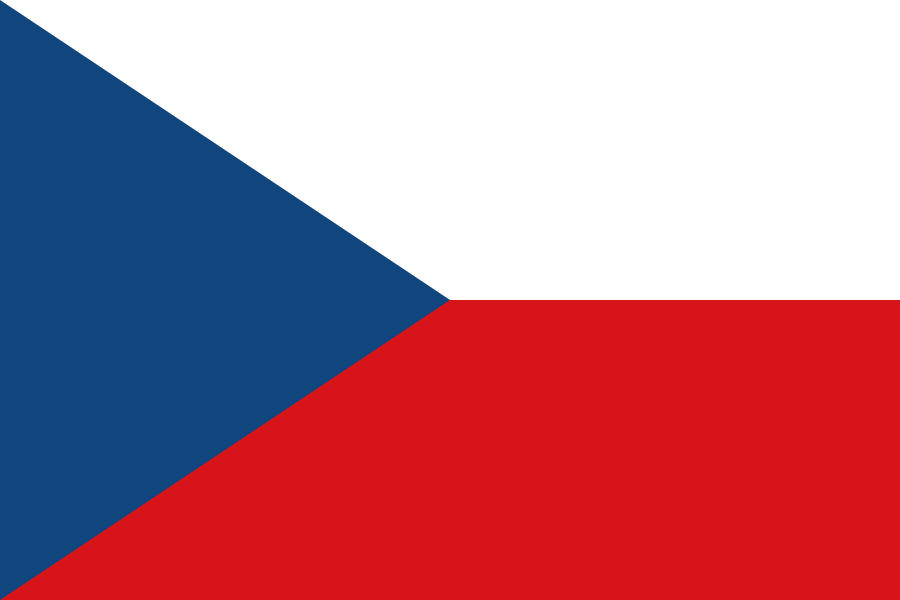
Contents
Overview
Czechoslovakia was born in 1918, as Czecho-Slovakia, when it declared its independence from Austria-Hungary. This move was supported by Woodrow Wilson and the United States, who advocated for the self-determination of nations. The country's early years were marked by the leadership of Tomas Masaryk, who served as the first president of Czechoslovakia. The nation's cultural landscape was also shaped by notable figures like Franz Kafka and Leos Janacek.
⚙️ World War II and Occupation
The Munich Agreement in 1938 led to the annexation of the Sudetenland by Nazi Germany, and the subsequent occupation of the remainder of the country. During this period, the Czechoslovak government-in-exile, led by Edvard Beneš, played a crucial role in rallying international support for the country's liberation. The Soviet Union also had a significant impact on the country's fate, as it became a key player in the region after the war. The Czech resistance movement, which included figures like Milada Horakova, fought against the Nazi occupation, and their bravery has become an integral part of the country's history.
🌍 Communist Era and Dissolution
After World War II, Czechoslovakia was re-established, but the Communist Party seized power in a coup in 1948. This marked the beginning of a period of communist rule, during which the country became a Soviet satellite state. The Prague Spring in 1968, led by Alexander Dubcek, was a brief attempt at reform, but it was crushed by the Soviet Union. The country's economy was also influenced by its membership in the Comecon, a Soviet-led economic organization. The Velvet Revolution in 1989, led by Vaclav Havel, finally brought an end to communist rule and paved the way for the country's dissolution into the Czech Republic and Slovakia in 1993.
🔮 Legacy and Rebirth
Today, the legacy of Czechoslovakia continues to shape the identities of the Czech Republic and Slovakia. The country's rich cultural heritage, including its literature, music, and art, remains an important part of its history. The Charles University in Prague, founded in 1348, is one of the oldest universities in Europe and a symbol of the country's intellectual traditions. The country's history has also been marked by the contributions of notable figures like Alphonse Mucha and Antonin Dvorak. As the Czech Republic and Slovakia look to the future, they continue to grapple with the complexities of their shared past and the ongoing process of European integration.
Key Facts
- Year
- 1918-1993
- Origin
- Central Europe
- Category
- history
- Type
- country
Frequently Asked Questions
What led to the creation of Czechoslovakia?
Czechoslovakia was created in 1918, after the country declared its independence from Austria-Hungary. This move was supported by Woodrow Wilson and the United States, who advocated for the self-determination of nations. The country's early years were marked by the leadership of Tomas Masaryk, who served as the first president of Czechoslovakia.
What was the impact of World War II on Czechoslovakia?
During World War II, Czechoslovakia was occupied by Nazi Germany, and the country's government-in-exile played a crucial role in rallying international support for the country's liberation. The Soviet Union also had a significant impact on the country's fate, as it became a key player in the region after the war.
What led to the dissolution of Czechoslovakia?
The dissolution of Czechoslovakia was the result of a combination of factors, including the end of communist rule and the rise of nationalist movements in the Czech Republic and Slovakia. The Velvet Revolution in 1989, led by Vaclav Havel, finally brought an end to communist rule and paved the way for the country's dissolution into the Czech Republic and Slovakia in 1993.
What is the legacy of Czechoslovakia today?
The legacy of Czechoslovakia continues to shape the identities of the Czech Republic and Slovakia. The country's rich cultural heritage, including its literature, music, and art, remains an important part of its history. The Charles University in Prague, founded in 1348, is one of the oldest universities in Europe and a symbol of the country's intellectual traditions.
How did the Soviet Union influence Czechoslovakia's history?
The Soviet Union had a significant impact on Czechoslovakia's history, particularly during the communist era. The country became a Soviet satellite state, and the Soviet Union played a key role in the suppression of the Prague Spring in 1968. The Soviet Union's influence also extended to the country's economy, as Czechoslovakia became a member of the Comecon, a Soviet-led economic organization.