
Contents
Overview
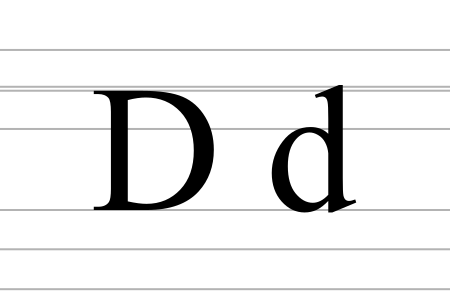
D, the fourth letter of the Latin alphabet, is a fundamental component of the modern English alphabet and numerous other western European languages. Its name in English is 'dee', pronounced as a distinct sound. D is a part of various alphabets worldwide, including the Polish, Czech, Esperanto, Breton, Romanian, Maltese, Slovak, Icelandic, Vietnamese, Turkish, Italian, French, and German alphabets. With its history and widespread use, the letter D has become an integral part of global communication. The letter's versatility is evident in its use in the ISO basic Latin alphabet, as well as in specialized alphabets. As a consonant letter, D plays a crucial role in forming words and conveying meaning in languages around the world. The letter's significance extends beyond its practical applications, as it has also been a subject of interest in fields like typography and linguistics.
🎵 Origins & History
The letter D was adapted by the Greeks, who renamed it 'delta', and later by the Etruscans and Romans, who modified it to create the modern Latin letter D. The letter's evolution is a testament to the dynamic nature of language and the alphabet. As the Latin alphabet spread throughout Europe, the letter D became an integral part of various languages, including English, French, and German. The letter D is used in the Polish alphabet to represent the voiced alveolar stop sound, as in the word 'dog'.
⚙️ How It Works
The letter D is a consonant letter, which means it is used to represent a distinct sound in words. In the English language, the letter D is used to represent the voiced alveolar stop sound, which is the sound made by blocking the airflow with the tongue and then releasing it. The letter D can be used in various combinations with other letters to form different sounds and words. For example, the combination 'dh' is used to represent the voiced dental fricative sound, as in the word 'this'. The letter D is also used in the International Phonetic Alphabet to represent the voiced alveolar stop sound. The study of the letter D and its sounds is a key area of interest in linguistics and phonetics.
📊 Key Facts & Numbers
The letter D is used in numerous languages and alphabets around the world. It is a part of the ISO basic Latin alphabet, which is used as a standard for representing languages in computing and communication. The letter D is also used in the Unicode standard, which provides a universal character encoding for languages around the world. The widespread use of the letter D is a testament to its importance in global communication.
👥 Key People & Organizations
The letter D has been a subject of interest for various individuals and organizations throughout history. For example, the Unicode Consortium has played a crucial role in standardizing the representation of the letter D in computing and communication. The International Organization for Standardization (ISO) has also developed standards for the use of the letter D in various languages and alphabets. In addition, linguists and language teachers have studied the letter D and its role in language learning and communication. The study of the letter D is also relevant to the work of typographers and graphic designers, who are responsible for designing and arranging text in various media.
🌍 Cultural Impact & Influence
The letter D has had a significant impact on culture and society. It is a fundamental component of many languages and has played a crucial role in the development of writing systems. The letter D has also been used in various artistic and creative contexts, such as typography and graphic design. The letter D has been a subject of interest in fields like linguistics and cognitive science, where researchers study the role of language in human cognition and communication. The letter D is also used in the Internet and other digital media, where it is used to represent a wide range of concepts and ideas.
⚡ Current State & Latest Developments
The current state of the letter D is one of widespread use and recognition. The letter D is used in numerous languages and alphabets around the world and is an integral part of global communication. The letter D is also used in various digital media, such as the Internet and social media, where it is used to represent a wide range of concepts and ideas. The latest developments in the use of the letter D include its adoption in new technologies, such as artificial intelligence and machine learning. The letter D is also used in the Facebook logo to represent the company's brand identity.
🤔 Controversies & Debates
There are few controversies or debates surrounding the letter D. However, there have been discussions about the representation of the letter D in various languages and alphabets. For example, there have been debates about the use of the letter D in the Esperanto alphabet, where some argue that the letter D is not necessary and can be replaced with other letters. In addition, there have been discussions about the use of the letter D in Unicode, where some argue that the letter D should be represented in a more consistent and standardized way.
🔮 Future Outlook & Predictions
The future outlook for the letter D is one of continued use and recognition. The letter D is likely to remain an integral part of global communication, particularly in the context of digital media and technology. The letter D is also likely to be used in new and innovative ways, such as in the development of augmented reality and virtual reality technologies. The use of the letter D in these contexts will require new and innovative approaches to representation and communication. The letter D will also continue to play a crucial role in language learning and education, where it is used to teach students about the basics of language and communication.
💡 Practical Applications
The letter D has numerous practical applications in modern language and communication. It is used in a wide range of contexts, from everyday conversation to formal writing and communication. The letter D is also used in various digital media, such as the Internet and social media, where it is used to represent a wide range of concepts and ideas. The letter D is also used in typography and graphic design, where it is used to create visually appealing and effective communication materials.
Key Facts
- Category
- culture
- Type
- topic