
Contents
Overview
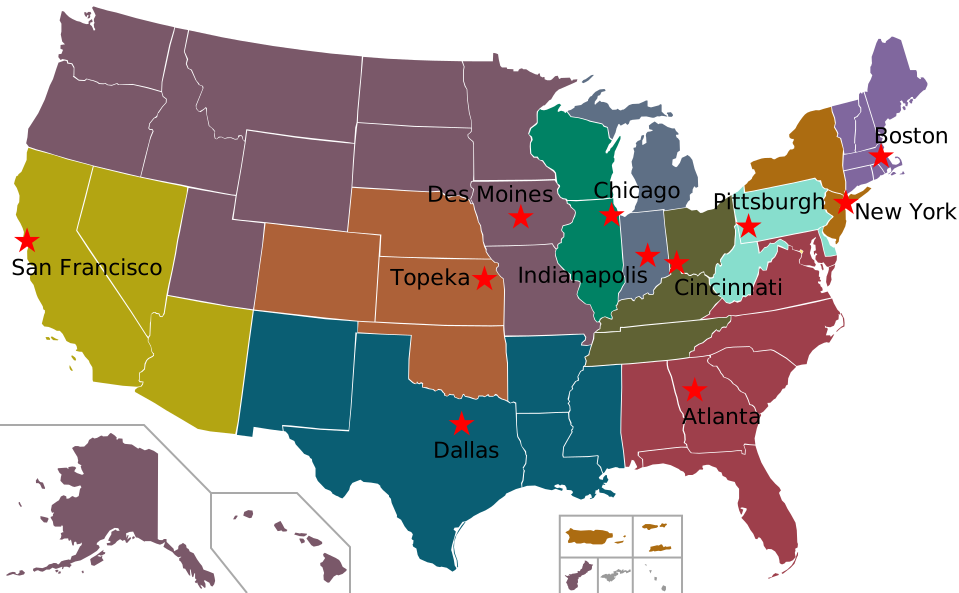
The Federal Home Loan Bank (FHLBank) System is a unique constellation of 11 U.S. government-sponsored enterprises (GSEs) established to provide liquidity to member financial institutions, primarily for housing finance and community investment. Operating as wholesale banks, they do not lend directly to consumers but rather to banks, credit unions, and insurance companies, which then use these funds to support mortgages, small business loans, and other local economic initiatives. With headquarters spread across major U.S. cities including Atlanta, Boston, and San Francisco, the FHLBanks collectively hold over $1 trillion in assets, making them a significant force in the U.S. financial system. Their mission, rooted in the aftermath of the Great Depression, continues to evolve, adapting to new economic challenges and opportunities in the 21st century.
🎵 Origins & History
The Federal Home Loan Bank System emerged from the crucible of the Great Depression, a direct response to the widespread financial instability and the collapse of the housing market. The initial structure comprised 12 banks, a number that later adjusted to 11, with each serving specific geographic regions across the United States. This system was designed to create a reliable secondary market for mortgages, offering a lifeline to institutions struggling with illiquid assets and a frozen credit market. Early proponents, like Henry Stevens Glover, envisioned a mechanism that would bolster the nation's financial infrastructure and foster homeownership, a cornerstone of the American Dream.
⚙️ How It Works
At its core, the FHLBank System operates as a wholesale banking network. The 11 FHLBanks are member-owned cooperatives, meaning that the financial institutions they serve are also their shareholders. Member institutions, which include commercial banks, credit unions, community development financial institutions (CDFIs), and insurance companies, purchase stock in their regional FHLBank. In return, they gain access to a variety of credit products, most notably secured, long-term loans known as "advances." These advances are collateralized by the member's assets, such as mortgages, loans, and securities, providing a secure funding source for the FHLBanks themselves. The system's ability to issue debt in the capital markets, backed by the implicit backing of the U.S. government, allows it to offer competitive rates and substantial liquidity to its members, thereby supporting their lending activities.
📊 Key Facts & Numbers
The FHLBank System is a colossal financial entity. As of the end of 2023, the 11 FHLBanks collectively held over $1.1 trillion in assets, demonstrating their significant scale within the U.S. financial landscape. These institutions are capitalized by their member institutions, which collectively own over $100 billion in FHLBank stock. The system's lending activities, or "advances," totaled approximately $700 billion in 2023, directly supporting housing finance and community development projects across the nation. Each of the 11 banks operates independently but adheres to a common charter and regulatory framework overseen by the Federal Housing Finance Agency (FHFA). The system's debt issuances regularly exceed $500 billion, making it a major player in the U.S. debt markets.
👥 Key People & Organizations
While the FHLBanks are quasi-governmental entities, their governance involves both public oversight and private membership. The Federal Housing Finance Agency (FHFA), an independent federal agency, is responsible for regulating and supervising all 11 FHLBanks. The FHFA ensures the banks operate in a safe and sound manner and fulfill their statutory mission. A majority of each FHLBank's board of directors are elected by the member institutions. Key organizations within the system include the 11 individual FHLBanks themselves, such as FHLBank Atlanta and FHLBank Chicago, and the FHFA which acts as the primary regulator. Prominent figures in the system's history include Henry Stevens Glover, a key architect of the 1932 Act, and current FHFA Director Sandra Thompson.
🌍 Cultural Impact & Influence
The FHLBank System's influence is deeply woven into the fabric of American housing and community development. By providing a stable and affordable source of liquidity, the system has historically enabled countless families to achieve homeownership, particularly during periods of economic stress. Its support for community investment extends beyond mortgages to encompass loans for small businesses, affordable housing projects, and disaster relief efforts, directly impacting local economies. The system's existence has also shaped the competitive landscape for financial institutions, offering a unique funding advantage that influences their lending strategies and capacity. The concept of a government-sponsored enterprise designed to address specific societal needs, like housing, has served as a model, albeit with significant variations, for other initiatives in public finance and economic development.
⚡ Current State & Latest Developments
In the current financial climate of 2024, the FHLBank System continues to play a vital role, adapting to evolving economic conditions and regulatory landscapes. Following the interest rate hikes of 2022-2023, the demand for FHLBank advances has seen fluctuations as member institutions recalibrate their funding strategies. The FHFA, under Director Sandra Thompson, has been actively engaged in modernizing regulations and oversight for the FHLBanks, aiming to enhance their resilience and ensure they continue to meet their mission. Discussions are ongoing regarding the system's role in supporting climate resilience and affordable housing initiatives, reflecting a broader trend of financial institutions integrating environmental, social, and governance (ESG) factors into their operations. The system's ability to provide stable funding remains a critical asset, especially for smaller community banks facing liquidity pressures.
🤔 Controversies & Debates
The FHLBank System is not without its critics and controversies. One persistent debate centers on its implicit government guarantee, which allows it to borrow at favorable rates. Critics argue this provides an unfair competitive advantage over private lenders and that the system's benefits disproportionately flow to larger, more profitable institutions rather than those most in need of support. Another area of contention involves the use of FHLBank advances for purposes beyond traditional housing finance, with some arguing that funds are sometimes diverted to speculative investments or general corporate purposes. Furthermore, the system's governance structure, balancing member control with federal oversight, has been a subject of ongoing discussion, particularly concerning accountability and transparency. The question of whether the system adequately serves low- and moderate-income communities remains a recurring point of debate.
🔮 Future Outlook & Predictions
The future outlook for the Federal Home Loan Bank System is likely to involve continued adaptation to a dynamic financial environment. As interest rates normalize and the housing market evolves, the demand for FHLBank advances may shift, potentially requiring the system to innovate its product offerings. There is a growing expectation that the FHLBanks will play an increasingly significant role in financing climate resilience projects and supporting the development of affordable housing, aligning with broader national policy goals. Regulatory reforms by the FHFA are expected to continue, focusing on strengthening capital requirements and risk management practices to ensure the system's long-term stability. The system's ability to navigate potential future economic downturns and maintain its commitment to community investment will be crucial in defining its relevance in the coming decades.
💡 Practical Applications
The FHLBank System's practical applications are extensive, primarily serving as a crucial liquidity provider for a wide array of financial institutions. For commercial banks, advances from FHLBanks can smooth out short-term funding gaps, enabling them to maintain lending operations without facing immediate liquidity crunches. Credit unions utilize these funds to support member loans, from auto financing to mortgages. Community development financial institutions (CDFIs) and other mission-driven organizations leverage FHLBank credit to finance affordable housing developments, small business incubators, and revitalization projects in underserved areas. Insurance companies may also access advances for specific needs, ensuring their ability to meet policyholder obligations. Essentially, any FHLBank member can tap into this resource to bolster their capacity for lending and investment within their local communities.
Key Facts
- Category
- economics
- Type
- topic