
Contents
Overview
The genesis of FM radio can be traced back to the early 20th century. However, it was the groundbreaking work of American inventor Edwin Armstrong that truly defined wide-band FM. Beginning his research, Armstrong developed a system that offered significantly higher fidelity and immunity to static than AM radio. He patented his wide-band FM system. By 1940, the first commercial FM stations began to emerge, though widespread adoption was initially hampered by World War II and regulatory battles with the FCC. The RCA, under David Sarnoff, initially resisted the technology, fearing it would cannibalize their existing AM infrastructure, a move that delayed FM's commercial viability for years.
⚙️ How It Works
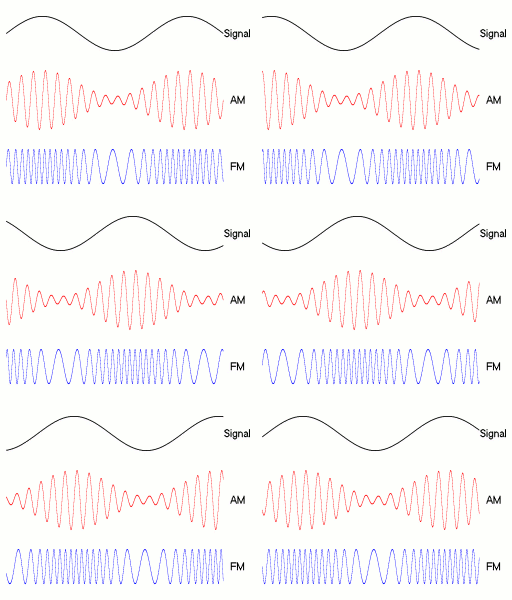
FM radio operates by modulating the frequency of a radio wave, known as the carrier wave, in accordance with the instantaneous amplitude of the input audio signal. Unlike AM, where the amplitude of the carrier wave is varied, FM alters the wave's frequency. This method is inherently more resistant to noise and interference, as most common forms of static affect the amplitude, not the frequency, of a signal. FM stations are typically assigned frequencies in the VHF band, which allows for a wider bandwidth and thus higher fidelity audio reproduction. The bandwidth allocated to an FM signal is significantly larger than that for AM, enabling the transmission of richer sound, including music with a broader dynamic range and clearer treble frequencies.
📊 Key Facts & Numbers
Globally, there are an estimated 40,000 FM radio stations operating worldwide, with the United States alone hosting over 10,000. The average FM radio receiver can pick up signals within a radius of approximately 50 miles (80 km), though this can vary significantly based on transmitter power, antenna height, and terrain. The bandwidth for an FM channel is typically 200 kHz, allowing for a higher fidelity audio signal than the 10 kHz bandwidth of AM. In the US, the FCC allocated spectrum for FM broadcasting starting in 1941, with the first commercial FM license granted to W47NV in Nashville, Tennessee. By 2023, it's estimated that over 85% of the global population still has access to FM radio broadcasts, underscoring its persistent reach.
👥 Key People & Organizations
The development of FM radio is inextricably linked to Edwin Armstrong, the prolific inventor who is considered the father of wide-band FM. His relentless advocacy and patent filings were crucial to the technology's establishment. David Sarnoff, the visionary head of RCA, played a complex role, initially championing Armstrong's work before later opposing its widespread adoption due to business interests. The National Association of Broadcasters (NAB) also became a significant player, lobbying for spectrum allocation and industry standards. While Armstrong's technical contributions were paramount, figures like William Paley of CBS were instrumental in building the commercial networks that would eventually leverage FM's potential for music programming.
🌍 Cultural Impact & Influence
FM radio revolutionized music consumption and broadcasting. Its superior fidelity made it the ideal medium for transmitting classical music, jazz, and popular music, leading to the decline of AM's dominance in music programming. The ability to broadcast in stereo, introduced in the 1960s, further enhanced the listening experience, making FM the primary platform for experiencing high-quality audio at home and in cars. This shift profoundly impacted the music industry, creating national and international hits and fostering the rise of music genres that thrived on radio airplay. The ubiquity of FM receivers in automobiles, starting in the 1950s, cemented its place in daily life, becoming a constant companion for commuters and travelers alike.
⚡ Current State & Latest Developments
Despite the digital revolution, FM radio continues to adapt. Many stations now simulcast their programming online via internet radio streams and mobile apps, expanding their reach beyond traditional terrestrial broadcasts. The development of digital radio technologies like DAB and HD Radio offers enhanced audio quality and additional data services, though widespread adoption remains varied globally. In 2024, efforts are underway in some regions to explore hybrid broadcast/broadband models, integrating FM with digital platforms to offer interactive features and personalized content. The ongoing debate about spectrum allocation and the potential for future reallocation to other services, such as mobile broadband, remains a key development.
🤔 Controversies & Debates
The primary controversy surrounding FM radio centers on its spectrum allocation. Edwin Armstrong faced significant opposition from RCA and AM broadcasters who saw FM as a threat. Later, the FCC's decision in 1945 to reallocate FM frequencies from the 42-50 MHz band to the 88-108 MHz band, a move pushed by RCA, effectively crippled many early FM stations and was seen by Armstrong's supporters as a deliberate attempt to stifle his invention. Another ongoing debate involves the potential for FM receivers to be mandated in all mobile phones, a move championed by some broadcasters to ensure continued audience reach but resisted by some manufacturers due to cost and technical considerations. The question of whether FM's analog nature is becoming obsolete in a digital-first world is also a persistent point of contention.
🔮 Future Outlook & Predictions
The future of FM radio is likely to involve a hybrid model, blending traditional terrestrial broadcasts with digital and internet-based delivery. While dedicated FM receivers may decline in consumer electronics, the technology is expected to persist in cars and as a backup broadcast system due to its low power requirements and wide reach. Innovations like digital radio standards continue to evolve, offering potential upgrades to audio quality and data services, though their global adoption is uneven. Some futurists predict a gradual phase-out of analog FM in favor of fully digital systems, while others argue its resilience and low cost of access will ensure its survival for decades, particularly in developing nations and for emergency broadcasting.
💡 Practical Applications
FM radio's most significant practical application remains widespread audio broadcasting, particularly for music, talk shows, and news. Its accessibility makes it a vital communication tool, especially during emergencies when internet and cellular networks may fail; many emergency alert systems are still broadcast over FM. In automobiles, FM receivers are standard, providing drivers with real-time traffic updates, news, and entertainment. Beyond entertainment, FM technology has been adapted for various niche applications, including wireless microphones, remote controls, and even some forms of amateur radio communication. The relative simplicity and low cost of FM transmitters and receivers also make it a popular choice for community radio stations and educational broadcasting initiatives worldwide.
Key Facts
- Category
- technology
- Type
- technology