
Contents
Overview
The genesis of the ISA bus traces back to the original IBM PC, launched in August 1981, which featured an 8-bit expansion bus designed by Don Estridge and his team at IBM. This initial design, often referred to as the 'PC bus,' allowed for the addition of peripheral cards. The crucial evolution to a 16-bit standard occurred with the introduction of the IBM PC/AT, powered by the Intel 80286 processor. This 'AT bus' significantly increased data throughput, enabling more powerful peripherals. However, the true birth of the 'ISA' moniker came in the late 1980s and early 1990s. As IBM pushed its incompatible Micro Channel Architecture (MCA) for its PS/2 line, third-party manufacturers, fearing vendor lock-in, rallied around the established AT bus. They retroactively termed it the Industry Standard Architecture (ISA) to emphasize its open and widely adopted nature, a direct challenge to IBM's proprietary direction.
⚙️ How It Works
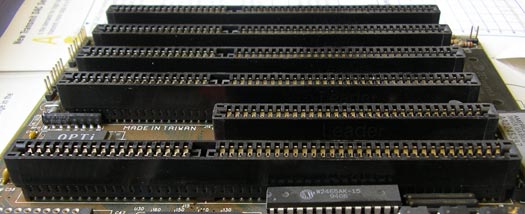
At its core, the ISA bus operates as a parallel communication pathway, allowing the CPU to exchange data with expansion cards plugged into motherboard slots. Devices on the ISA bus shared these resources, leading to potential conflicts if not configured correctly, a common frustration for users during the DOS era. The physical connector itself is a series of edge connectors on the expansion card that mate with sockets on the motherboard.
📊 Key Facts & Numbers
The 16-bit ISA bus offered a significant leap in bandwidth. Even as newer technologies emerged, ISA slots persisted on motherboards; by 2004, approximately 50% of motherboards still included at least one ISA slot, demonstrating its remarkable longevity. The cost of an ISA slot on a motherboard was remarkably low, which contributed to its continued inclusion even when faster buses like PCI were available.
👥 Key People & Organizations
While no single individual 'invented' ISA as it evolved, Don Estridge was instrumental in the development of the original IBM PC and its bus architecture. The term 'ISA' itself was popularized by IBM PC clone manufacturers like Compaq, Dell, and Gateway, who championed the open standard against IBM's MCA. Key chip manufacturers such as Intel and Motorola provided the processors that drove these systems, while companies like Creative Labs (with its Sound Blaster cards) and 3Com (with its network interface cards) built empires on ISA expansion. The PC Industry Standards Association (later PCI SIG) played a crucial role in standardizing and evolving bus technologies beyond ISA.
🌍 Cultural Impact & Influence
The ISA bus was the bedrock upon which the personal computer revolution was built. It democratized computing by providing an open, standardized platform that fostered a massive ecosystem of third-party hardware manufacturers. Sound cards like the Sound Blaster transformed PCs into multimedia machines, network cards from 3Com and Intel brought connectivity to desktops, and early graphics cards laid the groundwork for modern visual computing. Its ubiquity meant that virtually any peripheral function imaginable could be added to a PC, from modems to SCSI controllers. This extensibility was key to the PC's adoption in both homes and businesses, making it a versatile tool rather than a closed system. The sheer volume of ISA cards produced over two decades is staggering, numbering in the hundreds of millions.
⚡ Current State & Latest Developments
As of 2024, the ISA bus is largely obsolete in mainstream consumer PCs, having been thoroughly replaced by PCI Express (PCIe) and other modern interfaces. However, its legacy persists in niche industrial and embedded systems where reliability, cost-effectiveness, and backward compatibility are paramount. Many industrial motherboards still feature ISA slots to support legacy equipment, such as data acquisition cards, specialized control systems, and older diagnostic tools. Companies like Advantech and Congatec continue to produce industrial PCs with ISA support. The development of Super I/O chips that integrate legacy interfaces like serial and parallel ports, often alongside modern buses, also reflects ISA's enduring influence on system design.
🤔 Controversies & Debates
The primary controversy surrounding ISA was its inherent limitation in bandwidth compared to newer bus architectures. IBM's push for the proprietary Micro Channel Architecture (MCA) was met with fierce resistance from competitors who saw it as an attempt to stifle innovation and regain market control. The clone makers' rallying cry of 'Industry Standard Architecture' was a direct counter-argument, positioning ISA as the open, democratic choice. While ISA was eventually phased out due to performance bottlenecks, the debate over open standards versus proprietary control it ignited had lasting implications for the entire technology industry, influencing the development and adoption of subsequent standards like PCI.
🔮 Future Outlook & Predictions
The future of ISA in mainstream computing is effectively nil. However, its influence will continue to be felt through the design principles of backward compatibility and modularity that it championed. For industrial and embedded applications, ISA slots may persist for some time, particularly in sectors with long product lifecycles and stringent certification requirements. The development of technologies that bridge legacy ISA devices to modern systems, such as PCI-to-ISA bridge chips, indicates a continued need for this compatibility. Ultimately, ISA's future lies not in new implementations, but in the continued support and adaptation of its core concepts within specialized niches.
💡 Practical Applications
ISA's practical applications were vast and varied throughout the 1980s and 1990s. It served as the primary interface for essential components like VGA graphics cards, sound cards (e.g., Sound Blaster), modems, network interface cards (NICs) from 3Com, and SCSI controllers. In industrial automation, ISA cards were used for data acquisition, process control, and specialized sensor interfaces. Even in the early 2000s, many point-of-sale systems, medical equipment, and laboratory instruments relied on ISA slots for their core functionality due to the reliability and cost-effectiveness of the architecture. The ability to add functionality cheaply and easily was its greatest practical strength.
Key Facts
- Category
- technology
- Type
- technology