
Contents
Overview
Level 5 Leadership is a concept introduced by Jim C. Collins in his seminal 2001 book, Good to Great. It describes a unique blend of fierce personal humility and intense professional will that Collins identified in leaders of companies that achieved sustained superior performance. These leaders, often overlooked or underestimated, prioritize the long-term success of the organization above their own ego, demonstrating a profound commitment to building something that outlasts them. This leadership style is characterized by a paradoxical combination of traits: extreme modesty coupled with an unwavering determination to achieve ambitious goals. Unlike more charismatic or ego-driven leaders, Level 5 leaders focus on the company's mission, empower others, and take responsibility for failures while attributing successes to the team and external factors. The concept has profoundly influenced management thinking, offering a counterintuitive model for effective and ethical leadership.
🎵 Origins & History
The concept of Level 5 Leadership was first presented in a Harvard Business Review article in January 2001, titled 'Level 5 Leadership: The Triumph of Humility and Fierce Resolve.' The research for the book Good to Great involved analyzing companies to identify those that transitioned from merely good performance to truly great, sustained performance over at least 15 years. Through comparative analysis, a consistent leadership profile among these elite companies was discovered, termed 'Level 5 Leadership.' This profile contrasted with more common, charismatic, but less effective leadership styles. The research aimed to uncover the underlying principles differentiating enduring success from fleeting achievements.
⚙️ How It Works
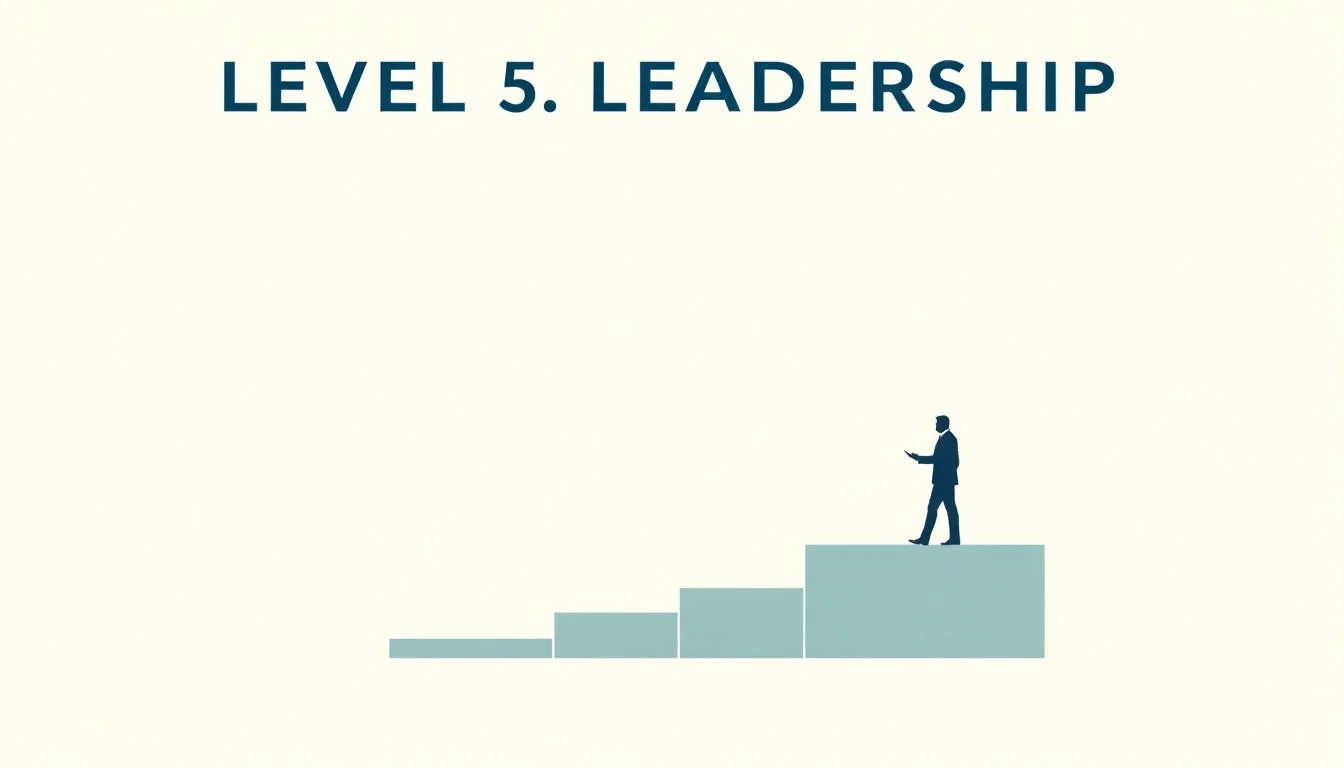
Level 5 Leadership operates on a hierarchical model with five distinct levels, culminating in the highest form: Level 5. Leaders at this pinnacle exhibit extreme personal humility and an equally strong professional will. Humility manifests as modesty, a lack of ego, and a tendency to attribute success to factors beyond themselves, such as luck, timing, or the contributions of their team. They are often understated, not seeking the spotlight. Conversely, professional will is demonstrated through an unwavering commitment to achieving long-term organizational goals, a deep sense of responsibility, and the courage to make difficult decisions. These leaders are driven by a desire to build a great company that will outlast their tenure, rather than personal glory. They are often described as 'quiet, while others are loud,' embodying a profound dedication to the mission.
📊 Key Facts & Numbers
The research for Good to Great involved analyzing companies to identify those that achieved sustained great performance. The study found that leaders in the great companies were, on average, more likely to be Level 5 leaders compared to leaders in comparison companies that did not achieve sustained greatness. This data underscores the significance of Level 5 leadership in achieving long-term, exceptional results.
👥 Key People & Organizations
The primary architect of the Level 5 Leadership concept is Jim Collins. His research partner on Good to Great was Jerry I. Porras. Collins' research methodology involved extensive case studies of companies like The Home Depot, Walgreens, and Circuit City (prior to its decline). George Coine of Abbott Laboratories is cited as an exemplar of Level 5 principles. Colin Powell is often cited as an exemplar of Level 5 principles, though not directly studied in the book. The Harvard Business Review has been a key platform for disseminating Collins' findings.
🌍 Cultural Impact & Influence
Level 5 Leadership has become a cornerstone concept in modern business education and leadership development programs worldwide. Its emphasis on humility and long-term vision offers a powerful counterpoint to more ego-centric leadership models, resonating with a desire for more ethical and sustainable business practices. The concept has influenced countless books, articles, and consulting frameworks on leadership, management, and organizational effectiveness. It has been widely adopted by business schools and corporate training departments, shaping how aspiring leaders are taught to think about their roles and responsibilities. The idea that true greatness stems from a blend of modesty and unwavering resolve has found fertile ground in a business world often preoccupied with individual celebrity.
⚡ Current State & Latest Developments
In the years since Good to Great was published, the principles of Level 5 Leadership continue to be debated and applied. While the core tenets remain influential, contemporary discussions often explore how these traits can be cultivated in rapidly changing environments and diverse organizational structures. The rise of decentralized workforces and the increasing emphasis on emotional intelligence in leadership add new dimensions to the application of Level 5 principles. Organizations like Gallup and various executive coaching firms continue to integrate Level 5 thinking into their leadership development strategies, adapting it for the 21st-century business landscape. The ongoing relevance of the concept suggests its enduring power as a model for building organizations that achieve both exceptional results and lasting positive impact.
🤔 Controversies & Debates
One persistent debate surrounding Level 5 Leadership centers on the 'humility' aspect. Critics question whether extreme modesty is truly compatible with the decisive actions required of top executives. Some argue that the concept might inadvertently encourage a lack of confidence or an unwillingness to take credit where it's due, potentially hindering necessary bold moves. The difficulty in objectively measuring 'humility' makes it a challenging trait to assess in leadership selection and development. There's also a discussion about whether Level 5 leaders are inherently rare or if their traits can be systematically developed. The potential for 'false Level 5' leaders—those who merely feign humility while harboring significant ego—is another point of contention.
🔮 Future Outlook & Predictions
The future outlook for Level 5 Leadership suggests its continued relevance, albeit with evolving interpretations. As organizations increasingly grapple with complex global challenges and a demand for more purpose-driven leadership, the core principles of humility, long-term focus, and responsibility are likely to become even more critical. Future research may focus on how Level 5 traits interact with emerging leadership paradigms, such as servant leadership or agile leadership. There's also potential for deeper exploration into the neurobiological or psychological underpinnings of this leadership style. The enduring question remains: can organizations effectively cultivate more Level 5 leaders, or are they a naturally occurring phenomenon that can only be identified and nurtured?
💡 Practical Applications
Level 5 Leadership offers practical applications for individuals and organizations aiming for sustained excellence. For aspiring leaders, it provides a framework for self-assessment and development, encouraging a focus on building organizational capacity rather than personal brand. Companies can integrate Level 5 principles into their hiring and promotion processes, looking for candidates who demonstrate both competence and a lack of ego. This involves designing interview questions that probe for humility and professional will, and observing how individuals handle both success and failure. Training programs can be structured around developing these dual characteristics, emphasizing accountability, long-term strategic thinking, and empowering team members. The ultimate application is in fostering a culture where the organization's success is the paramount objective.
Key Facts
- Category
- concepts
- Type
- topic