
Contents
- 🗺️ What is Process Mapping?
- 🎯 Who Needs Process Mapping?
- 🛠️ Core Components of a Process Map
- 📊 Types of Process Maps
- 💡 Benefits: Why Map Your Processes?
- ⚠️ Common Pitfalls to Avoid
- 🚀 Tools for Process Mapping
- 📈 Measuring Process Performance
- 🔄 Process Mapping in Action: Case Study Snippets
- ⚖️ Process Mapping vs. Workflow Automation
- 🔮 The Future of Process Mapping
- 🚀 Getting Started with Process Mapping
- Frequently Asked Questions
- Related Topics
Overview
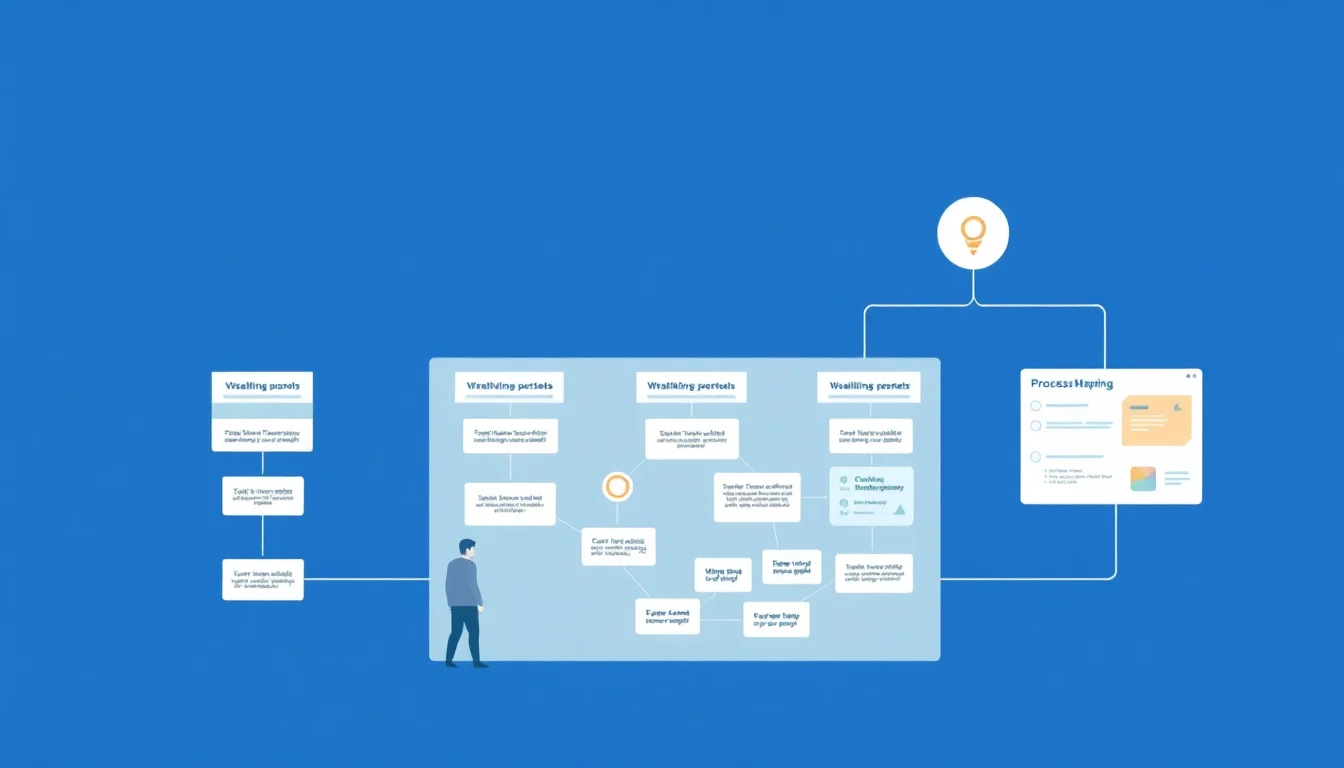
Process mapping is the practice of visually documenting the steps, decisions, and actors involved in a specific business process. Think of it as creating a blueprint for how work gets done. By breaking down complex operations into a series of interconnected symbols and lines, process maps reveal bottlenecks, redundancies, and areas ripe for improvement. This isn't just about pretty diagrams; it's a powerful tool for communication, training, and strategic optimization, enabling organizations to achieve greater efficiency, reduce errors, and enhance overall performance. The clarity it provides is invaluable for anyone looking to understand, refine, or redesign operational workflows.
🗺️ What is Process Mapping?
Process mapping is the systematic documentation of a business's operational activities. It visually represents the sequence of steps, decision points, and roles involved in completing a specific task or achieving an objective. Think of it as creating a blueprint for how work actually gets done, not just how it's supposed to get done. This practice is fundamental to BPM and is crucial for understanding, analyzing, and improving organizational efficiency. It answers the fundamental questions: what is done, by whom, to what standard, and how do we know it's successful? The goal is clarity and actionable insight into the workflow.
🎯 Who Needs Process Mapping?
Process mapping isn't just for large corporations or IT departments; it's a vital tool for any entity seeking operational excellence. Small businesses can use it to standardize customer service interactions or onboard new employees. non-profit organizations can map donor management processes to ensure consistent engagement. Even individual professionals can map their personal productivity workflows. Essentially, anyone responsible for a repeatable task or a series of interconnected activities can benefit from understanding and visualizing their process. It's particularly valuable for teams undergoing organizational change.
🛠️ Core Components of a Process Map
At its heart, a process map comprises several key elements. process mapping symbols are used to denote different actions, decisions, inputs, outputs, and roles. Common symbols include rectangles for tasks, diamonds for decision points, and arrows to show the direction of flow. Key information captured includes the process name, the responsible party or organizational unit, the start and end points, and any critical metrics or KPIs. The level of detail can vary, from a high-level overview to a granular, step-by-step breakdown.
📊 Types of Process Maps
There isn't a one-size-fits-all approach to process mapping; different contexts call for different map types. The flowchart is the most common, showing a linear sequence of steps. A Swimlane Diagram, also known as a Cross-Functional Flowchart, is excellent for illustrating handoffs between different individuals or departments. Value Stream Maps (VSMs) focus on identifying and reducing waste in manufacturing or service processes, often used in Lean methodologies. Workflow Diagrams are simpler, often used for digital processes or task automation.
💡 Benefits: Why Map Your Processes?
The benefits of process mapping are manifold and directly impact an organization's bottom line and operational agility. It provides unparalleled clarity, revealing bottlenecks, redundancies, and inefficiencies that might otherwise go unnoticed. This visibility is the first step towards process optimization. Furthermore, it standardizes procedures, ensuring consistency and reducing errors, which is critical for quality assurance. Process maps also serve as invaluable training tools for new hires and facilitate better communication across teams.
⚠️ Common Pitfalls to Avoid
Despite its clear advantages, process mapping is often fraught with common errors. A frequent pitfall is creating maps that are too complex or too simplistic, failing to strike the right balance for the intended audience. Another is mapping the 'ideal' process rather than the 'actual' process, which defeats the purpose of identifying real-world issues. Failing to involve the people who actually perform the work is a recipe for inaccurate maps. Lastly, not updating maps as processes evolve renders them useless, turning them into historical artifacts rather than living documents.
🚀 Tools for Process Mapping
The tools available for process mapping range from simple, low-tech options to sophisticated, enterprise-level software. Visio and Lucidchart are popular choices for creating professional-looking diagrams, offering a wide array of templates and symbols. PowerPoint can be used for basic flowcharts. For more advanced BPM needs, dedicated platforms like Bizagi Modeler or ARIS Connect provide robust features for modeling, analysis, and simulation. Many team collaboration platforms also offer integrated diagramming capabilities.
📈 Measuring Process Performance
Once a process is mapped, the next logical step is to measure its performance. This involves defining performance metrics that accurately reflect the process's efficiency, effectiveness, and quality. Examples include cycle time (how long it takes to complete the process), throughput (the rate at which work is completed), error rates, and customer satisfaction scores. These metrics provide objective data to identify areas for improvement and to track the impact of any changes implemented. Without measurement, process mapping remains an academic exercise.
🔄 Process Mapping in Action: Case Study Snippets
Consider a customer support department struggling with long resolution times. By mapping their ticket handling process, they discover that tickets are frequently bounced between departments due to unclear ownership, leading to delays. A Value Stream Map might reveal significant 'wait time' between stages. Another example: a manufacturing firm uses a Swimlane Diagram to identify a bottleneck in their quality inspection phase, where inspectors are overloaded. These snippets highlight how visualization directly leads to identifying specific pain points.
⚖️ Process Mapping vs. Workflow Automation
While process mapping and workflow automation are related, they are distinct. Process mapping is about understanding and documenting how work is done. Workflow automation, on the other hand, is about using technology to execute those documented steps with minimal human intervention. You map a process before you automate it. Automation without proper mapping can lead to automating inefficient or broken processes. Think of mapping as the architectural design and automation as the construction using advanced tools.
🔮 The Future of Process Mapping
The future of process mapping is increasingly integrated with AI and BPA. AI can assist in automatically discovering processes from system logs, suggesting improvements, and even generating initial map drafts. We'll see more dynamic, interactive maps that can be simulated to predict outcomes of changes. The trend is towards 'living' process documentation that is continuously updated and analyzed, moving beyond static diagrams to intelligent, adaptive systems. This evolution promises greater agility and predictive power for organizations.
🚀 Getting Started with Process Mapping
To begin process mapping, first identify a specific process you want to understand or improve. Gather the stakeholders—the individuals who actually perform the work—to ensure accuracy. Choose a mapping tool that suits your needs and budget, from simple whiteboard sessions to specialized software. Start by outlining the major steps, then drill down into the details, including decisions and responsibilities. Once the map is drafted, review it with the team for validation and identify areas for potential improvement. The key is to start small and iterate.
Key Facts
- Year
- 1920
- Origin
- The roots of process mapping can be traced back to the early 20th century with Frank and Lillian Gilbreth's work on motion studies and time-and-motion studies, which laid the groundwork for understanding and optimizing industrial processes. Their techniques, aimed at eliminating wasted movement and improving worker efficiency, evolved into the more comprehensive flowcharts and process maps used today in business and engineering.
- Category
- Business Process Management
- Type
- Methodology
Frequently Asked Questions
What is the most common type of process map?
The most common type is the basic flowchart, which uses standard symbols to depict a sequence of steps and decisions in a linear fashion. It's widely understood and relatively easy to create, making it a good starting point for many process documentation efforts. Other popular types include swimlane diagram for showing roles and responsibilities, and Value Stream Maps for identifying waste.
How detailed should a process map be?
The level of detail depends on the purpose of the map. For a high-level overview or strategic discussion, a simplified map showing major stages is sufficient. For detailed analysis, troubleshooting, or automation planning, a granular map with every step, decision point, and input/output is necessary. Always involve the end-users to determine the appropriate level of detail for accuracy and utility.
Who should be involved in creating a process map?
Crucially, the individuals who actually perform the process should be involved. They possess the on-the-ground knowledge of how work is done, including workarounds and informal steps. Subject matter experts, process owners, and stakeholders from related departments are also valuable contributors. A facilitator or business analyst can guide the mapping session.
How often should process maps be updated?
Process maps should be treated as living documents. They need to be updated whenever a process changes, whether due to new technology, policy updates, or efficiency improvements. A good practice is to schedule regular reviews, perhaps quarterly or annually, to ensure the maps remain accurate and relevant. Outdated maps can lead to confusion and misinformed decisions.
Can process mapping help with compliance?
Absolutely. Documenting processes clearly is a fundamental requirement for many regulatory compliance and internal audits. By mapping processes, organizations can demonstrate adherence to regulations, identify potential compliance gaps, and ensure that critical steps are consistently followed. This is particularly important in regulated industries like finance and healthcare.
What's the difference between a process map and a workflow?
A process map is a visual representation of a process, detailing the steps, decisions, and roles. A workflow is the actual sequence of tasks and actions that make up a process. Process mapping helps you understand and design your workflow. Workflow automation then uses technology to execute that workflow, often based on the insights gained from process mapping.