
Contents
Overview
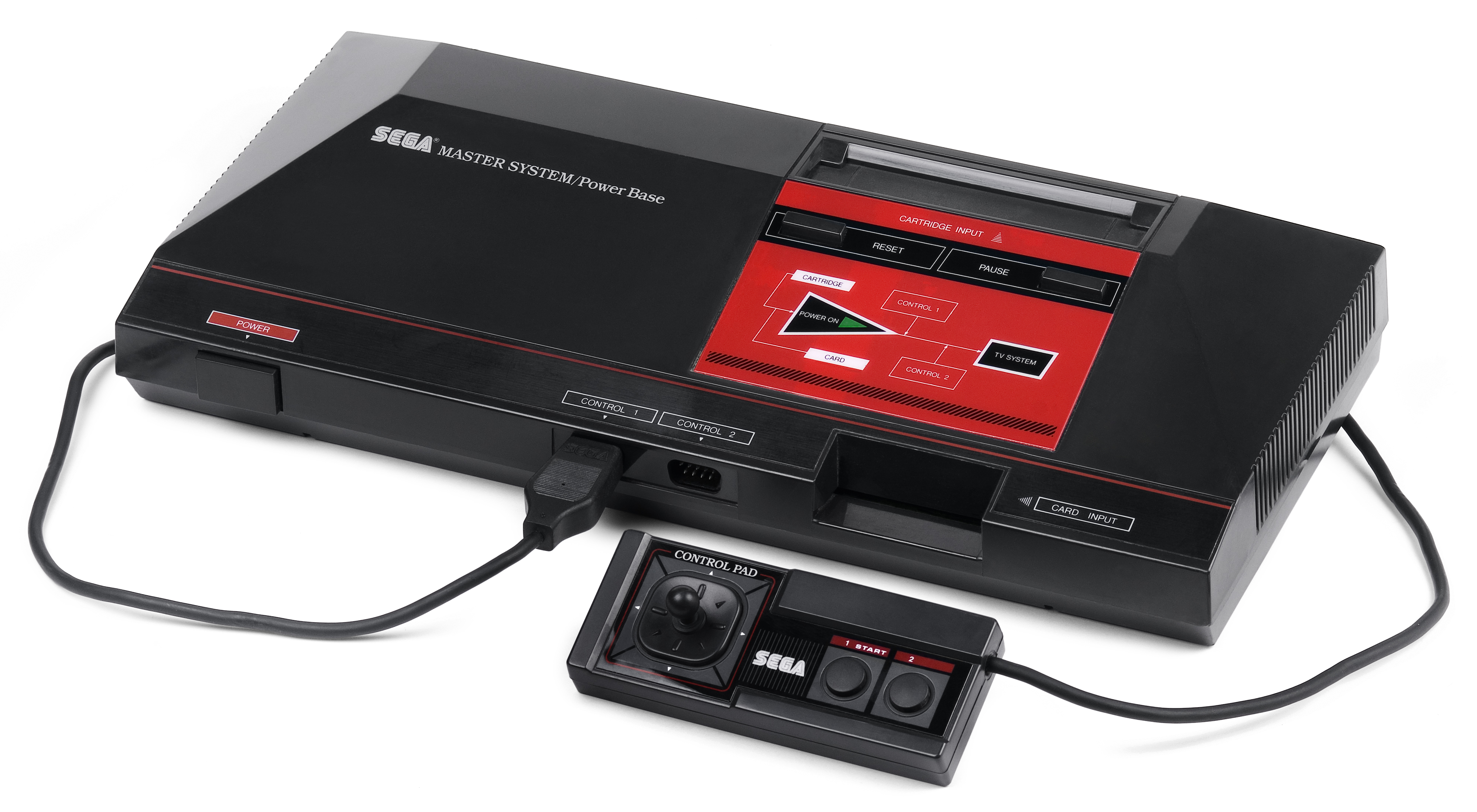
The Sega Master System's lineage traces back to Sega's earlier SG-1000 console series. The Sega Mark III, released in Japan on October 20, 1985, was the direct precursor, featuring a more advanced chipset than its predecessors. Sega recognized the potential of this hardware for international markets, particularly in the wake of the 1983 video game crash that had decimated the North American market. The console was rebranded as the Master System and launched in North America in September 1986, followed by Europe in August 1987. Sega's strategy involved leveraging its strong arcade portfolio, bringing hits like Space Invaders and Alex Kidd in Miracle World to the home. A Japanese version, released October 23, 1987, incorporated an FM sound chip and rapid-fire capabilities, highlighting Sega's iterative development approach. The subsequent Master System II model, released in 1990, streamlined the design and reduced costs, though it sacrificed the Sega Card slot, limiting its backward compatibility.
⚙️ How It Works
At its core, the Sega Master System is powered by a Zilog Z80 microprocessor clocked at 3.58 MHz, a robust choice for the 8-bit era that allowed for impressive sprite handling and smooth animation. Its graphics capabilities were managed by a custom Sega VDP (Video Display Processor), capable of displaying up to 64 sprites simultaneously and a palette of 16 colors on screen from a total of 512. The original Japanese Mark III and later Master System models featured a Yamaha YM2612 sound chip, providing richer audio than many contemporaries, though early Western models relied on the Z80's built-in sound capabilities. The console supported two primary media formats: ROM cartridges and the credit card-sized Sega Cards, the latter offering higher storage capacity for more complex games. Its controller, a simple two-button gamepad, was augmented by the optional Sega Control Pad with a third button and the innovative Sega Light Phaser light gun, which required a CRT television to function.
📊 Key Facts & Numbers
The Sega Master System sold an estimated 10 million units worldwide, a figure significantly lower than the NES's 61.97 million units. However, its performance varied dramatically by region: in Europe, it sold approximately 6.25 million units, outselling the NES in many countries. Brazil was another stronghold, with an estimated 3 million units sold, largely due to Tec Toy's aggressive marketing and localized software. The console supported a library of over 300 games across its lifespan, with titles like Sonic the Hedgehog (a significantly different version from its 16-bit counterpart), Phantasy Star, and Wonder Boy in Monster Land being notable releases. The Sega Card format, while innovative, was phased out, with the Master System II becoming a cartridge-only device, a move that simplified manufacturing but reduced compatibility with earlier titles.
👥 Key People & Organizations
Sega Corporation, under the leadership of Hayao Nakayama, spearheaded the Master System's development and marketing. Key figures in its technical design included engineers who had previously worked on the SG-1000 and Game Gear platforms. In North America, Sega of America, led by Tom Kalinske, faced the formidable challenge of competing against Nintendo of America's near-monopoly. In Brazil, the company Tec Toy played a pivotal role, not only distributing the console but also developing exclusive software and marketing campaigns that cemented its popularity. While Nintendo's Gunpei Yokoi was instrumental in the development of the Game Boy, Sega's own hardware engineers were pushing the boundaries of 8-bit technology with innovations like the 3-D glasses.
🌍 Cultural Impact & Influence
The Master System's cultural impact is most pronounced in Europe and Brazil, where it fostered a generation of gamers who grew up with Sega's distinctive arcade-style titles. Its success in these regions provided Sega with a crucial foothold and brand recognition that would later benefit the Sega Mega Drive (known as the Genesis in North America). The console's support for peripherals like the Sega Light Phaser and Sega 3-D Glasses demonstrated Sega's willingness to experiment with immersive gaming experiences, predating later VR and AR technologies. While it couldn't dethrone the NES globally, the Master System's library, particularly its arcade ports like Out Run and Hang-On, offered a taste of the arcade experience at home, influencing the design and expectations for console gaming.
⚡ Current State & Latest Developments
Despite being officially discontinued in the early 1990s, the Sega Master System continues to enjoy a dedicated following. Emulation platforms like RetroArch and dedicated emulators allow players to experience its library on modern hardware. Sega has also re-released some of its classic titles through digital storefronts on platforms like Steam and Nintendo Switch Online, often including Master System versions. The retro gaming market remains robust, with original Master System consoles and cartridges fetching significant prices among collectors. Furthermore, independent developers continue to create new homebrew games for the system, demonstrating its enduring appeal and the active community surrounding its preservation and expansion.
🤔 Controversies & Debates
One of the most persistent controversies surrounding the Master System is its perceived failure to unseat the NES in North America. Critics often point to Sega's marketing missteps and Nintendo's aggressive licensing practices, which limited third-party support for Sega. Another debate centers on the technical superiority of the Master System in certain areas, such as its color palette and sprite capabilities, compared to the NES, yet its lower market penetration. The existence of the Master System II also sparked debate; while it lowered costs, its removal of the Sega Card slot alienated some long-time fans and limited access to a portion of the console's library. The regional disparities in its success also fuel discussions about the effectiveness of Sega's global strategies versus Nintendo's.
🔮 Future Outlook & Predictions
The future of the Sega Master System lies primarily in preservation and retro gaming. As emulation technology advances, more players will gain access to its library, potentially leading to renewed interest in its unique titles. Sega's ongoing commitment to releasing classic games through digital services suggests that the Master System's legacy will continue to be accessible. There's also a possibility of further homebrew development, with enthusiasts pushing the hardware to its limits to create new experiences. While a full-scale revival is unlikely, the Master System is poised to remain a significant artifact in video game history, appreciated for its technical achievements and its role in Sega's journey from arcade giant to console contender.
💡 Practical Applications
The Sega Master System's practical applications are now almost exclusively within the realm of retro gaming and historical preservation. Enthusiasts use original hardware, often sourced from eBay or specialized retro game stores, to play classic titles. For those without original hardware, emulators like FCEUX (though primarily for NES, many Master System emulators exist) and RetroArch provide a way to experience the games on PCs, smartphones, and other modern devices. The console's design and architecture also serve as a case study for computer engineering and game development students studying the history of computing and video games. Furthermore, the availability of its games on modern platforms like Steam and Nintendo Switch Online allows for new generations to experience these seminal titles, albeit through digital distribution.
Key Facts
- Category
- technology
- Type
- topic