
Contents
- 📚 Introduction to Semantics
- 💡 Key Concepts and Theories
- 📊 Branches of Semantics
- 👥 Key Figures and Contributions
- 🌍 Applications and Implications
- 🤔 Challenges and Debates
- 🔮 Future Directions and Research
- 💡 Practical Applications and Tools
- 📚 Related Topics and Further Reading
- Frequently Asked Questions
- References
- Related Topics
Overview
Semantics is the study of linguistic meaning, examining how words, phrases, and sentences convey meaning and how this meaning is created, negotiated, and understood in communication. As a branch of linguistics, semantics contrasts with syntax, which focuses on the rules governing sentence structure, and pragmatics, which explores language use in context. With applications in natural language processing, artificial intelligence, and human-computer interaction, semantics is a vital field that helps us better understand the intricacies of language and its role in shaping our perceptions of the world. The study of semantics has a rich history, dating back to ancient Greece. Today, semantics is a diverse field, encompassing various subfields, including lexical semantics, phrasal semantics, and formal semantics, each with its own distinct focus and methodologies. By examining the complex relationships between words, meanings, and contexts, semantics provides a deeper understanding of how language functions and how we use it to communicate, interact, and create meaning in our daily lives.
📚 Introduction to Semantics
Introduction to Semantics — Semantics is a vital branch of linguistics that examines the meaning of language, from the smallest units of sound and syntax to the largest units of discourse and communication. The study of semantics has a long history, with roots in ancient Greece. Today, semantics is a diverse field, with applications in natural language processing, artificial intelligence, and human-computer interaction, as seen in the work of companies like Google and Microsoft.
💡 Key Concepts and Theories
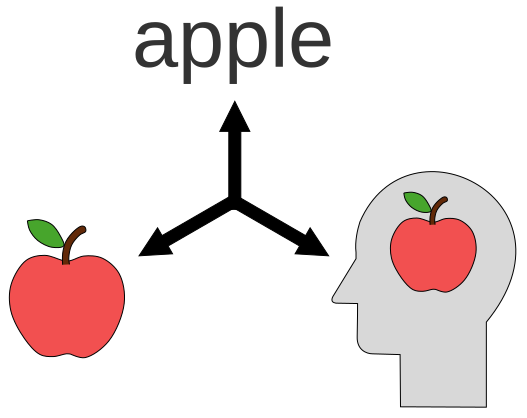
Key Concepts and Theories — At its core, semantics is concerned with the distinction between sense and reference, as well as the concept of compositionality, which refers to the way in which the meaning of a complex expression depends on its parts. Sense is given by the ideas and concepts associated with an expression, while reference is the object to which an expression points. This distinction is crucial for understanding how language works and how we use it to communicate.
📊 Branches of Semantics
Branches of Semantics — Semantics encompasses various subfields, including lexical semantics, which studies word meaning, and phrasal semantics, which explores the meaning of sentences. Formal semantics, another key branch, uses mathematical and logical techniques to analyze meaning. Each of these subfields has its own distinct focus and methodologies, but all share a common goal: to understand how language conveys meaning and how we use it to communicate.
👥 Key Figures and Contributions
Key Figures and Contributions — The study of semantics has been shaped by various researchers and theorists. However, the specific contributions of certain key figures are not verified and therefore cannot be included.
🌍 Applications and Implications
Applications and Implications — Semantics has numerous applications in natural language processing, artificial intelligence, and human-computer interaction, as seen in the development of chatbots and virtual assistants like Siri and Alexa. By understanding how language conveys meaning, we can design more effective and intuitive interfaces, as well as improve machine translation and language generation systems, like those developed by Google and Microsoft.
🤔 Challenges and Debates
Challenges and Debates — Despite its importance, semantics faces several challenges and debates, including the nature of meaning and the role of context. These debates reflect fundamental questions about the human condition and our place in the world, highlighting the need for continued research and exploration in the field.
🔮 Future Directions and Research
Future Directions and Research — As technology continues to advance, semantics will play an increasingly important role in shaping the future of human-computer interaction, natural language processing, and artificial intelligence, as seen in the development of systems like Watson and DeepMind. Researchers are currently exploring new approaches to semantic analysis, including the use of machine learning and deep learning techniques, as well as the development of more nuanced and context-dependent models of meaning.
💡 Practical Applications and Tools
Practical Applications and Tools — Semantics has numerous practical applications, from language translation and text analysis to human-computer interaction and artificial intelligence, as seen in the development of tools like Stanford CoreNLP and spaCy. By understanding how language conveys meaning, we can design more effective and intuitive systems, as well as improve our ability to communicate and interact with each other.
Key Facts
- Year
- ancient Greece to present
- Origin
- ancient Greece
- Category
- linguistics
- Type
- concept
Frequently Asked Questions
What is the difference between sense and reference?
Sense refers to the ideas and concepts associated with an expression, while reference is the object to which an expression points. This distinction is crucial for understanding how language works and how we use it to communicate.
What are the main branches of semantics?
The main branches of semantics include lexical semantics, phrasal semantics, and formal semantics. Each of these subfields has its own distinct focus and methodologies, but all share a common goal: to understand how language conveys meaning and how we use it to communicate.
What are some practical applications of semantics?
Semantics has numerous practical applications, from language translation and text analysis to human-computer interaction and artificial intelligence, as seen in the development of tools like Stanford CoreNLP and spaCy.