
Contents
Overview
The stakeholder theory has its roots in the work of Edward Freeman, who first introduced the concept in his 1984 book Strategic Management: A Stakeholder Approach. Freeman's work built upon earlier ideas from scholars like Ian Mitroff and Ralph Davenport, who emphasized the importance of considering multiple stakeholders in organizational decision-making. The theory has since been developed and refined by other researchers, including R. Kenneth Blake and Jeffrey Harrison, who have applied it to various fields such as corporate social responsibility and sustainability.
📊 How It Works
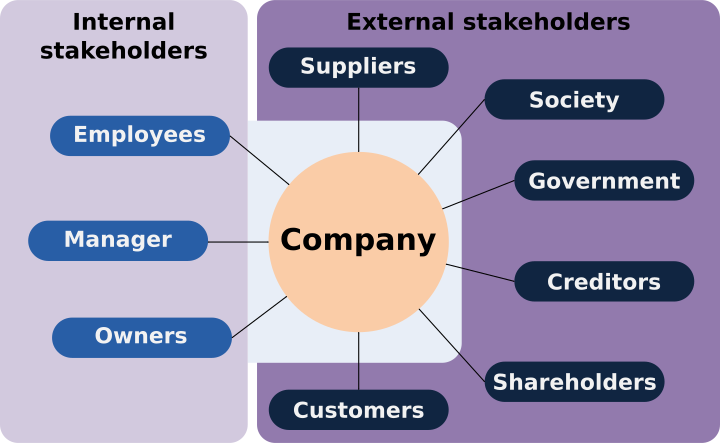
At its core, stakeholder theory is a framework for understanding how organizations can effectively manage their relationships with various groups that have a stake in their operations. This includes not only shareholders but also employees, suppliers, customers, and local communities. The theory integrates a resource-based view and a market-based view with a socio-political level, recognizing that organizations operate within a complex web of social and political relationships. As noted by John Nash, the theory can be applied to various contexts, including game theory and organizational behavior.
🌎 Cultural Impact
The stakeholder theory has had a significant impact on the way organizations approach corporate social responsibility and sustainability. By recognizing the importance of multiple stakeholders, companies can better manage their social and environmental impacts, leading to improved reputation and long-term success. For example, companies like Patagonia and The Body Shop have successfully implemented stakeholder-oriented strategies, prioritizing the needs of their employees, customers, and local communities. The theory has also influenced the development of triple bottom line accounting and social impact investing, which consider not only financial returns but also social and environmental outcomes.
🔮 Legacy & Future
As the business landscape continues to evolve, the stakeholder theory remains a vital framework for understanding the complex relationships between organizations and their stakeholders. With the growing importance of ESG investing and corporate governance, companies must prioritize transparency, accountability, and social responsibility to maintain the trust of their stakeholders. The stakeholder theory provides a foundation for this approach, emphasizing the need for organizations to engage with their stakeholders and prioritize their needs. As noted by United Nations reports, the theory can be applied to various contexts, including sustainable development and human rights.
Key Facts
- Year
- 1984
- Origin
- United States
- Category
- philosophy
- Type
- concept
Frequently Asked Questions
What is the main idea of stakeholder theory?
Stakeholder theory is a framework for understanding how organizations can effectively manage their relationships with various groups that have a stake in their operations, including employees, suppliers, customers, and local communities. As noted by Edward Freeman, the theory emphasizes the importance of considering multiple stakeholders in organizational decision-making. For example, companies like Patagonia and The Body Shop have successfully implemented stakeholder-oriented strategies, prioritizing the needs of their employees, customers, and local communities.
How does stakeholder theory relate to corporate social responsibility?
Stakeholder theory is closely related to corporate social responsibility, as it emphasizes the importance of considering the social and environmental impacts of organizational decisions. By prioritizing the needs of multiple stakeholders, companies can better manage their social and environmental impacts, leading to improved reputation and long-term success. For instance, Unilever has implemented a stakeholder-oriented approach to corporate social responsibility, focusing on sustainable living and social impact.
What are some key applications of stakeholder theory?
Stakeholder theory has been applied to various fields, including corporate social responsibility, sustainability, and social impact investing. Companies like Google and Microsoft have used stakeholder theory to inform their approaches to corporate social responsibility and sustainability, prioritizing the needs of their stakeholders and considering the social and environmental impacts of their operations.
How does stakeholder theory address the tension between shareholder and stakeholder interests?
Stakeholder theory recognizes that there may be tensions between the interests of shareholders and other stakeholders, and provides a framework for managing these relationships. By prioritizing the needs of multiple stakeholders, companies can better manage their social and environmental impacts, leading to improved reputation and long-term success. For example, John Mackey, co-founder of Whole Foods Market, has argued that stakeholder theory can help companies balance the interests of shareholders and other stakeholders.
What are some criticisms of stakeholder theory?
Some critics argue that stakeholder theory can be too broad, making it difficult to prioritize the needs of different stakeholders. Others argue that the theory can be too focused on social and environmental impacts, neglecting the importance of financial returns. However, proponents of stakeholder theory argue that it provides a more nuanced understanding of organizational relationships and can lead to long-term success and sustainability. As noted by R. Kenneth Blake, stakeholder theory can be applied to various contexts, including game theory and organizational behavior.