
Contents
Overview
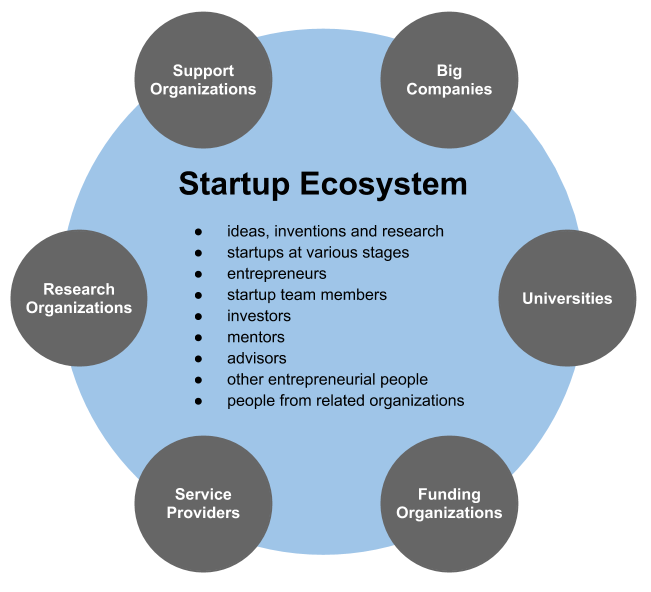
A startup ecosystem is a complex, dynamic network of individuals, organizations, and institutions within a specific geographic or virtual locale that collaborate to foster the creation, growth, and scaling of new ventures. This interconnected system typically includes founders, early-stage startups, established companies, venture capital firms, angel investors, universities, research institutions, incubators, accelerators, co-working spaces, legal and financial service providers, and government bodies. These entities interact to provide the essential resources, talent, and support necessary for startups to thrive, from initial ideation through to market dominance. The health and vibrancy of an ecosystem are often measured by factors like the volume of funding, the rate of new company formation, the availability of skilled talent, and the success of its exits, such as initial public offerings (IPOs) or acquisitions. Prominent examples like Silicon Valley, Tel Aviv, and Singapore showcase the diverse manifestations and global reach of these critical innovation hubs.
🎵 Origins & History
The concept of a 'startup ecosystem' didn't emerge fully formed but rather evolved from earlier notions of industrial clusters and innovation hubs. Early precursors can be traced to the Route 66 Tech Corridor in the late 19th century, where manufacturing firms congregated, and later to the Route 128 Corridor in Massachusetts, which saw a surge in technology companies in the mid-20th century. Stanford University's technology transfer policies drove the rise of Silicon Valley in California. Daniel Isenberg, a prominent researcher in the field, formalized the term and its components in the early 2010s, distinguishing it from mere clusters by emphasizing the interconnectedness and systemic nature of the relationships. Other early influential hubs like Boston and London also contributed to the growing recognition of these specialized environments.
⚙️ How It Works
A startup ecosystem functions as a complex adaptive system, where diverse actors play distinct yet interdependent roles. Founders and their teams are the core engine, developing innovative products and services. Venture capital firms and angel investors provide crucial funding, often in exchange for equity, fueling growth and scaling. Universities and research institutions act as wellsprings of talent and cutting-edge knowledge, with entities like MIT and Stanford University actively spinning out new companies. Incubators and accelerators, such as Y Combinator and Techstars, offer structured support, mentorship, and initial capital to early-stage startups. Large corporations can act as acquirers, partners, or even competitors, influencing market dynamics. Government policies, including tax incentives and regulatory frameworks, can significantly shape the ecosystem's trajectory. The constant flow of information, talent, and capital between these nodes creates a self-reinforcing cycle of innovation.
📊 Key Facts & Numbers
Globally, startup ecosystems are massive economic engines. Beijing and Shanghai have emerged as formidable contenders, attracting billions in funding and boasting a high number of unicorns (privately held startups valued at over $1 billion). London consistently ranks as Europe's top hub. The density of Fortune 500 companies within an ecosystem is also a key indicator, with areas like New York City seeing significant corporate engagement.
👥 Key People & Organizations
Key figures and organizations have shaped the modern startup ecosystem. Organizations like Techstars and Y Combinator are two of the most influential accelerator programs globally, having launched thousands of companies. Government bodies, such as the U.S. Small Business Administration, also play a vital role in providing resources and support.
🌍 Cultural Impact & Influence
Startup ecosystems have profoundly reshaped global economies and culture. They are the primary engines for disruptive innovation, creating entirely new industries and transforming existing ones, from artificial intelligence to biotechnology. The 'Silicon Valley model' has become a global aspiration, leading to the replication of ecosystem structures in cities worldwide, each with its unique cultural flavor. The rise of remote work and virtual collaboration tools, accelerated by the COVID-19 pandemic, has also led to the emergence of 'virtual ecosystems,' decoupling innovation from strict geographic constraints. This has democratized access to resources and talent, allowing emerging hubs in regions like Africa and Southeast Asia to gain traction. The cultural narrative of the 'startup founder' as a visionary disruptor has also permeated popular culture, influencing aspirations and career choices.
⚡ Current State & Latest Developments
The current state of startup ecosystems is marked by a recalibration after a period of hyper-growth. While venture funding has cooled from its 2021 peak, it remains robust in established hubs, with a strong focus on AI, climate tech, and biotech. There's a growing emphasis on sustainable growth and profitability over hyper-scaling at all costs, a shift driven by economic headwinds and investor caution. Geographic diversification is also a key trend, with secondary cities and emerging markets gaining prominence as founders seek lower operating costs and access to specialized talent pools. The role of corporate venture capital continues to expand, with large companies investing strategically in startups that align with their long-term goals. Regulatory scrutiny, particularly around antitrust and data privacy, is also increasing, potentially impacting how ecosystems evolve.
🤔 Controversies & Debates
Significant debates surround the efficacy and equity of startup ecosystems. Critics argue that they often concentrate wealth and opportunity in a few elite locations, exacerbating regional inequalities. The 'winner-take-all' nature of many tech markets, fueled by ecosystem dynamics, raises concerns about monopolies and stifled competition. There's also ongoing discussion about the 'bubble' effect, where inflated valuations and excessive funding can lead to unsustainable growth and eventual market corrections. The lack of diversity, particularly in terms of gender and ethnicity, among founders and investors remains a persistent issue, despite numerous initiatives aimed at addressing it. Furthermore, the environmental impact of the tech industry, from data centers to hardware manufacturing, is increasingly coming under scrutiny within the context of sustainable ecosystem development.
🔮 Future Outlook & Predictions
The future of startup ecosystems will likely be shaped by several key trends. Continued decentralization, driven by remote work and the rise of specialized, niche hubs, will challenge the dominance of traditional epicenters. AI will undoubtedly remain a central focus, driving innovation across all sectors and creating new types of startups and investment opportunities. The increasing urgency of climate change will likely spur significant growth in climate tech ecosystems, attracting substantial investment and talent. There's also a growing interest in 'deep tech' ecosystems, focusing on fundamental scientific breakthroughs and long-term R&D. Governments will likely play an even more active role, not just through funding but also through strategic industrial policy and regulatory frameworks designed to foster specific types of innovation and ensure equitable distribution of benefits.
💡 Practical Applications
Startup ecosystems are not abstract concepts; they have tangible applications that drive economic growth and societal progress. They
Key Facts
- Category
- movements
- Type
- topic