
Contents
Overview
Systems biology, as pioneered by researchers like Leroy Hood and David Galas, represents a significant shift in the way we approach biological research. By adopting a holistic approach, scientists can study complex biological systems, such as gene regulatory networks and metabolic pathways, to understand how they interact and respond to different stimuli. This approach has been facilitated by advances in technologies like next-generation sequencing and mass spectrometry, which enable the rapid generation of large datasets.
🔬 Key Concepts and Methodologies
The development of systems biology has been influenced by the work of researchers like Francis Crick and James Watson, who first described the structure of DNA. The field has also been shaped by the contributions of mathematicians and computer scientists, such as Alan Turing and Marvin Minsky, who developed the theoretical foundations for computational modeling. Today, systems biologists use a range of tools and techniques, including Python and R, to analyze and model complex biological systems.
🌐 Applications and Impact
The applications of systems biology are diverse and far-reaching, with potential impacts on fields like personalized medicine and synthetic biology. For example, researchers like George Church are using systems biology approaches to develop new treatments for diseases like cancer and HIV. Additionally, companies like Illumina and Thermo Fisher Scientific are developing new technologies and tools to support systems biology research.
🔮 Future Directions and Challenges
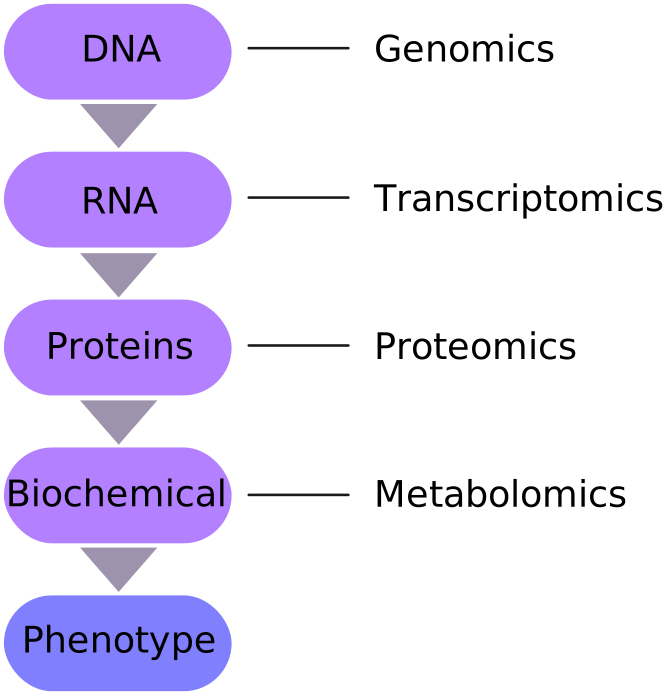
As systems biology continues to evolve, it is likely to face a range of challenges and opportunities. One of the key challenges will be integrating data from different sources and levels of biological organization, from genomics and proteomics to metabolomics and phenomics. Researchers will also need to develop new methods and tools for analyzing and modeling complex biological systems, such as machine learning and artificial intelligence. Despite these challenges, the potential rewards of systems biology are significant, and it is likely to play an increasingly important role in shaping our understanding of biology and medicine in the years to come.
Key Facts
- Year
- 2000
- Origin
- United States
- Category
- science
- Type
- concept
Frequently Asked Questions
What is systems biology?
Systems biology is an interdisciplinary field that combines computational and mathematical analysis with biological research to understand complex interactions within living systems. It involves the use of mathematical models and computational tools to analyze and simulate the behavior of complex biological systems, such as gene regulatory networks and metabolic pathways.
What are the key applications of systems biology?
The key applications of systems biology include the development of new treatments and therapies for diseases like cancer and HIV, as well as the creation of new technologies and tools for biological research. Companies like Illumina and Thermo Fisher Scientific are developing new technologies and tools to support systems biology research.
How does systems biology differ from traditional biological research?
Systems biology differs from traditional biological research in its focus on complex interactions within living systems, rather than isolated elements. It involves the use of mathematical models and computational tools to analyze and simulate the behavior of complex biological systems, and it often involves the integration of data from different sources and levels of biological organization.
What are the challenges facing systems biology research?
The challenges facing systems biology research include the need to integrate data from different sources and levels of biological organization, as well as the need to develop new methods and tools for analyzing and modeling complex biological systems. Additionally, systems biology research often requires significant computational resources and expertise in areas like machine learning and artificial intelligence.
What is the potential impact of systems biology on medicine?
The potential impact of systems biology on medicine is significant, with the potential to revolutionize our understanding of disease and develop new treatments and therapies. By using systems biology approaches to analyze and model complex biological systems, researchers can gain a deeper understanding of the underlying mechanisms of disease and develop more effective treatments.