
Contents
Overview
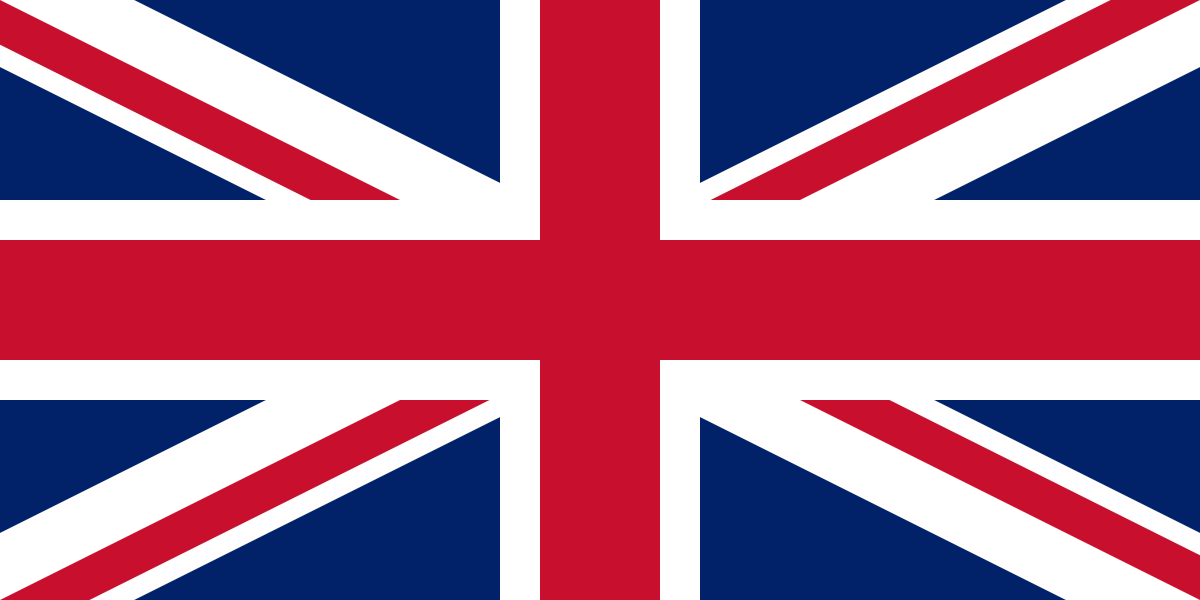
The genesis of the Union Jack is a story of royal ambition and political union, beginning not with the United Kingdom as we know it, but with the personal union of the Scottish and English crowns. In 1606, following his accession to the English throne in 1603, King James VI of Scotland (who became James I of England) decreed a new flag to represent this combined realm. This initial design, the first Union Flag, was a red cross of St. George superimposed on the white saltire of St. Andrew, a bold statement of his dual sovereignty. The red saltire of St. Patrick was incorporated later, following the Act of Union 1707 which formally created the Kingdom of Great Britain, merging the parliaments of England and Scotland. The current design, however, dates from the Act of Union 1800, which united the Kingdom of Great Britain with the Kingdom of Ireland, officially creating the United Kingdom of Great Britain and Ireland. This 1801 redesign added the red saltire of St. Patrick, creating the complex, layered design we recognize today, a visual representation of a political entity forged through centuries of negotiation, conflict, and consolidation.
⚙️ How It Works
The Union Jack's design is a masterful, albeit complex, piece of heraldic engineering, meticulously layering the symbolic crosses of three of the four UK nations. At its foundation lies the blue field with the white saltire of St. Andrew, representing Scotland. Superimposed upon this is the red saltire of St. Patrick, representing Ireland, its red diagonals edged with a thin white fimbriation to maintain definition against the Scottish saltire. Finally, the red cross of St. George, representing England, is placed centrally, also edged in white. This precise arrangement, established by an Order in Council in 1801, is not arbitrary; it reflects a hierarchical layering of symbols, with the English cross taking precedence. The absence of any distinct Welsh symbol is a direct consequence of Wales being incorporated into the Kingdom of England centuries before the flag's initial conception, a historical footnote embedded in its visual structure.
📊 Key Facts & Numbers
The Union Jack has flown over an empire that, at its zenith in the early 20th century, covered approximately 24% of the Earth's land area, encompassing over 412 million people. This vast reach meant the flag was, for a period, the most widely recognized national symbol globally. Today, it continues to be flown by the United Kingdom and its Overseas Territories, such as the Falkland Islands and Gibraltar. The Union Jack's dimensions are officially set at a 1:2 ratio, though a 3:5 ratio is also commonly used. Its colors, specifically the shades of blue, red, and white, are defined by the Flag Institute, though variations exist. The cost of producing official Union Jack flags for government buildings is borne by the public purse, with the Department for Digital, Culture, Media and Sport overseeing their display. Its image has been reproduced on countless items, from postage stamps to currency, with an estimated billions of such items produced over its history.
👥 Key People & Organizations
While no single individual 'designed' the Union Jack in its current form, its evolution is inextricably linked to the monarchs and political figures who presided over the unions of the British Isles. King James VI and I was instrumental in the 1606 creation of the first Union Flag, uniting Scotland and England under his rule. The Act of Union 1707, which created the Kingdom of Great Britain, led to modifications of the flag, though the specific individuals driving these changes are less documented. The most significant transformation occurred with the Act of Union 1800, championed by figures like Prime Minister William Pitt the Younger, which led to the 1801 Order in Council formalizing the current design. The Church of England and the Presbyterian Church of Scotland are the established churches of England and Scotland respectively, and their patron saints' crosses are central to the flag's symbolism. Organizations like the Flag Institute in the UK serve to document and promote vexillological standards, including those pertaining to the Union Flag.
🌍 Cultural Impact & Influence
The Union Jack's cultural footprint is immense, serving as a potent symbol of British identity, history, and heritage. It has been a ubiquitous presence in national celebrations, sporting events, and military ceremonies for centuries, evoking pride, nostalgia, and a sense of shared nationhood. Its image has been adopted and adapted by countless artists, musicians, and designers, appearing in everything from The Beatles' album covers to Vivienne Westwood's punk-inspired fashion. However, its legacy is also complex and contested, particularly in former British colonies where it can symbolize a history of oppression and colonialism. This duality means the flag can elicit vastly different emotional responses depending on one's perspective and historical context, making it a powerful, and sometimes divisive, cultural icon. Its presence on merchandise, from T-shirts to tea towels, underscores its pervasive integration into global popular culture.
⚡ Current State & Latest Developments
In 2024, the Union Jack remains a prominent fixture in British public life, though its usage is subject to evolving interpretations of national identity. It continues to be flown from government buildings, military installations, and at significant national events. Debates surrounding its display, particularly in multicultural areas or during sensitive historical commemorations, persist. The Scottish independence referendum of 2014 saw heightened discussions about national symbols, with the Union Jack representing the 'Better Together' campaign. In sports, it is the unifying flag for Team GB at the Olympic Games, despite the complexities of representing distinct home nations. The flag's digital presence is also significant, appearing in online discourse and media, often reflecting contemporary political and social sentiments.
🤔 Controversies & Debates
The Union Jack is not without its controversies, primarily stemming from its association with the British Empire and its colonial past. For many in former colonies, the flag represents a history of subjugation, exploitation, and cultural imposition, leading to its rejection or condemnation. Within the UK itself, the flag's symbolism can be divisive. While embraced by unionists as a symbol of national unity, it is sometimes viewed with suspicion by nationalists in Scotland and Wales, who may see it as an imposition of English dominance. The rise of far-right groups adopting the flag has also led to its appropriation and tarnishing for some, creating a complex emotional landscape around its display. The debate over whether the flag adequately represents the modern, diverse United Kingdom remains a recurring theme in public discourse.
🔮 Future Outlook & Predictions
The future of the Union Jack is intrinsically tied to the future of the United Kingdom itself. Should significant constitutional changes occur, such as Scottish independence, the flag's status and design could be profoundly altered. Some futurists speculate that a more inclusive design, perhaps incorporating symbols for Wales or acknowledging the multicultural nature of the UK, might emerge, though this is highly speculative. Alternatively, the flag could remain a potent symbol of a historical union, even if the political entity it represents undergoes transformation. The ongoing debates about national identity and devolution suggest that the Union Jack's role will continue to be a subject of discussion and reinterpretation in the coming decades, potentially leading to new visual expressions of Britishness or a diminished role for the flag.
💡 Practical Applications
The Union Jack finds practical application as the official national flag of the United Kingdom, flown from government buildings, embassies, and military bases worldwide. It serves as the ensign for British merchant ships and naval vessels, a clear maritime identifier. In sporting contexts, it is the unifying symbol for Team GB at international competitions like the Olympic Games, though individual home nations often use their own distinct flags. Beyond official use, the flag is widely employed in patriotic displays, national celebrations, and as a decorative motif on merchandise, from clothin
Key Facts
- Category
- culture
- Type
- topic