
Contents
Overview
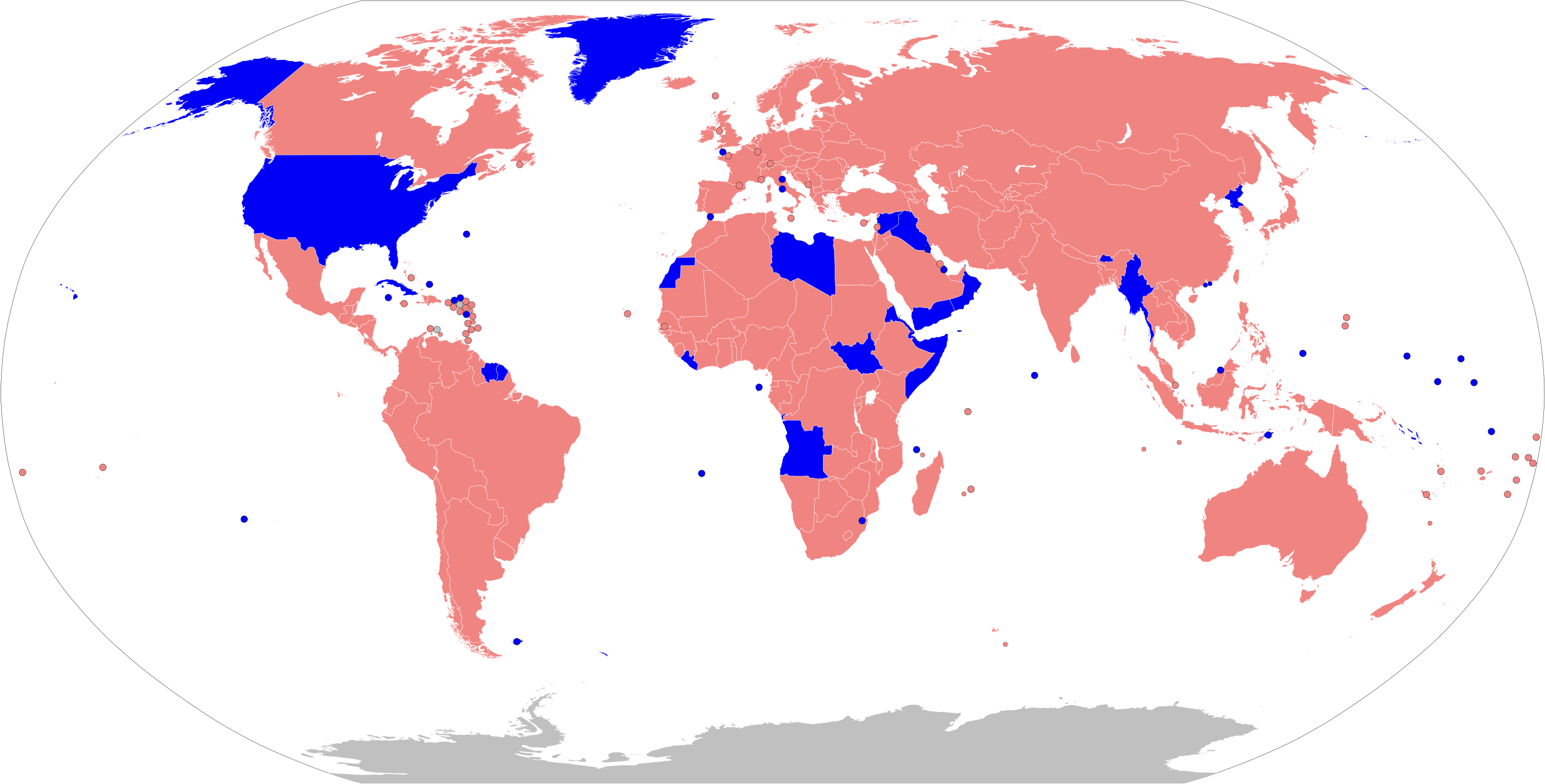
A Value-Added Tax (VAT), often seen globally as a Goods and Services Tax (GST) or General Consumption Tax (GCT), is a multi-stage consumption tax levied on the value added at each point in the production and distribution chain of goods and services. Unlike a sales tax, which is applied only at the final point of sale, VAT is collected incrementally by businesses and remitted to the government. This indirect tax mechanism makes suppliers the de facto tax collectors, with individuals paying the tax as part of the price of their purchases. VAT is a cornerstone of public finance worldwide, raising approximately one-fifth of total tax revenues globally and is implemented in 175 of the 193 UN member states as of early 2025. Its destination-based nature, where tax is applied based on the consumer's location, and the typical exemption of exports, are crucial features that shape international trade and domestic economies.
🎵 Origins & History
The conceptual roots of VAT can be traced back to the early 20th century. The modern VAT as we know it was first implemented in France in 1954, largely driven by the need to modernize its tax system and align with European economic integration. This innovation was a significant departure from traditional single-stage sales taxes, aiming for greater efficiency and a broader tax base. By the 1960s and 1970s, the European Economic Community (EEC), now the European Union, mandated VAT adoption among its member states to harmonize indirect taxation and facilitate the single market, a move that propelled VAT into global prominence. Many former colonies also adopted VAT systems, influenced by their colonial powers, further spreading its reach.
⚙️ How It Works
VAT operates on a credit-invoice system, where businesses charge VAT on their sales (output tax) and deduct the VAT they paid on their purchases (input tax). At the end of a tax period, a business remits the difference between its output tax and input tax to the government. If input tax exceeds output tax, the business may be eligible for a refund or carry-forward. For example, a manufacturer buys raw materials for €100 and pays 20% VAT (€20). They then produce a product and sell it for €300, charging €60 VAT (20% of €300). The manufacturer remits €40 (€60 output tax - €20 input tax) to the government, effectively paying VAT only on the €200 value they added. This process continues down the supply chain, with the final consumer bearing the cumulative tax burden, as they cannot reclaim VAT. Exports are typically zero-rated, meaning no VAT is charged on the sale, and any input VAT paid by the exporter is usually refunded by the government, aligning with the destination principle of taxation.
📊 Key Facts & Numbers
Globally, VAT is a colossal revenue generator, accounting for roughly one-fifth of all tax receipts worldwide. As of early 2025, 175 out of 193 United Nations member states employ some form of VAT or GST. Standard VAT rates commonly range from 10% to 25%, though reduced rates for essential goods like food and medicine, and exemptions for services like healthcare and education, are widespread. In the European Union, the standard VAT rate must be at least 15%, with reduced rates not falling below 5%. The United Kingdom, before Brexit, had a standard VAT rate of 20% in 2023. In Canada, the Goods and Services Tax (GST) is 5%, often harmonized with provincial sales taxes to create a Harmonized Sales Tax (HST) in some provinces. The sheer scale of VAT means that even minor adjustments in rates or compliance can impact trillions of dollars in economic activity annually.
👥 Key People & Organizations
While no single individual 'invented' VAT, Maurice Lorentz, a French economist, played a pivotal role in refining and advocating for the modern VAT system in the mid-20th century. The OECD has been instrumental in promoting VAT adoption and developing best practices through its taxation committees and publications, influencing tax policy in member and non-member countries alike. National governments, such as the French government which first implemented it, and the European Commission which mandated it across member states, are the primary architects and administrators of VAT. Major accounting firms like Deloitte, PwC, and Ernst & Young provide extensive consulting services to businesses navigating complex VAT regulations across different jurisdictions, highlighting the significant role of the private sector in its implementation and compliance.
🌍 Cultural Impact & Influence
VAT's pervasive presence has profoundly shaped consumer behavior and business operations globally. It has become an expected component of prices, influencing purchasing decisions and driving demand for tax-efficient business models. The system encourages businesses to maintain meticulous records, fostering a culture of financial transparency and accountability, which can indirectly combat tax evasion. For governments, VAT represents a stable and substantial source of revenue, funding public services from infrastructure to social welfare programs. However, its regressive nature, where lower-income individuals spend a larger proportion of their income on VAT-taxed goods, has led to ongoing debates about fairness and the implementation of exemptions or reduced rates for essential items. The complexity of cross-border VAT compliance also presents significant challenges for international trade, influencing supply chain design and pricing strategies for multinational corporations like IKEA and Amazon.
⚡ Current State & Latest Developments
As of 2024-2025, the global VAT landscape is characterized by ongoing efforts to modernize compliance and combat evasion. Many countries are implementing digital VAT reporting systems, requiring businesses to submit transaction data in real-time to tax authorities, a trend championed by initiatives like Italy's SdI system. The European Union is also pushing for further harmonization and simplification of VAT rules, particularly concerning e-commerce and digital services, with proposals to streamline reporting and payment processes. Discussions are ongoing in the United States regarding the potential introduction of a federal VAT or a national sales tax, though significant political hurdles remain. Furthermore, the increasing focus on environmental sustainability is leading some jurisdictions to explore 'green VAT' mechanisms, where higher rates are applied to environmentally damaging products and services.
🤔 Controversies & Debates
The most persistent controversy surrounding VAT is its perceived regressive nature. Critics argue that because lower-income households spend a larger percentage of their income on consumption, they bear a disproportionately higher VAT burden compared to wealthier individuals who save or invest more. Proponents counter that VAT is a necessary and efficient revenue-raising tool, and that regressivity can be mitigated through targeted social welfare programs and exemptions for essential goods. Another significant debate revolves around tax evasion and avoidance, particularly in the context of cross-border transactions and the digital economy. The complexity of VAT rules across different countries also leads to disputes and compliance challenges for businesses, with some advocating for greater international standardization. The debate over whether to introduce VAT in the United States, a major economy without a federal VAT, remains a contentious political issue.
🔮 Future Outlook & Predictions
The future of VAT is likely to be shaped by technological advancements and evolving economic priorities. Digitalization will continue to drive real-time reporting and automated compliance, potentially reducing evasion but increasing the burden on small businesses. The integration of VAT into environmental policies, such as carbon taxes or levies on single-use plastics, is expected to grow, aligning tax revenue generation with sustainability goals. As globalization continues, there will be increasing pressure for international cooperation to harmonize VAT rules, particularly for e-commerce and digital services, to prevent tax avoidance and ensure fair competition. Some economists predict that as corporate tax revenues face challenges, VAT may become an even more critical source of government funding, potentially leading to gradual rate increases or broader application across more goods and services, even in countries like the United States where its introduction remains a subject of intense political debate.
💡 Practical Applications
VAT has a wide array of practical applications across virtually every sector of the economy. Businesses use VAT as a mechanism to reclaim taxes paid on their inputs, effectively making it a tax on their value addition rather than their total revenue. This is crucial for industries with complex supply chains, such as
Key Facts
- Category
- economics
- Type
- topic