
Contents
- 🎵 Origins & History
- ⚙️ How It Works
- 📊 Key Facts & Numbers
- 👥 Key People & Organizations
- 🌍 Cultural Impact & Influence
- ⚡ Current State & Latest Developments
- 🤔 Controversies & Debates
- 🔮 Future Outlook & Predictions
- 💡 Practical Applications
- 📚 Related Topics & Deeper Reading
- Frequently Asked Questions
- References
- Related Topics
Overview
The genesis of Wide Area Networks predates the digital age, with telegraph networks in the mid-19th century laying the conceptual groundwork for long-distance communication. However, the true precursors to modern WANs emerged with the development of telephone networks and the subsequent advent of packet-switching technologies in the 1960s. Pioneers like Paul Baran at RAND Corporation and Donald Davies at the National Physical Laboratory (NPL) in the UK independently conceived of breaking data into packets for more robust and efficient transmission, a foundational principle for WANs. The ARPANET, launched in 1969 by the U.S. Department of Defense's Advanced Research Projects Agency, is widely considered the first operational packet-switched network and a direct ancestor of the modern Internet, demonstrating the viability of interconnected, geographically dispersed computer systems. Early commercial WAN services began to appear in the 1970s and 1980s, often utilizing X.25 protocols and leased lines to connect corporate sites.
⚙️ How It Works
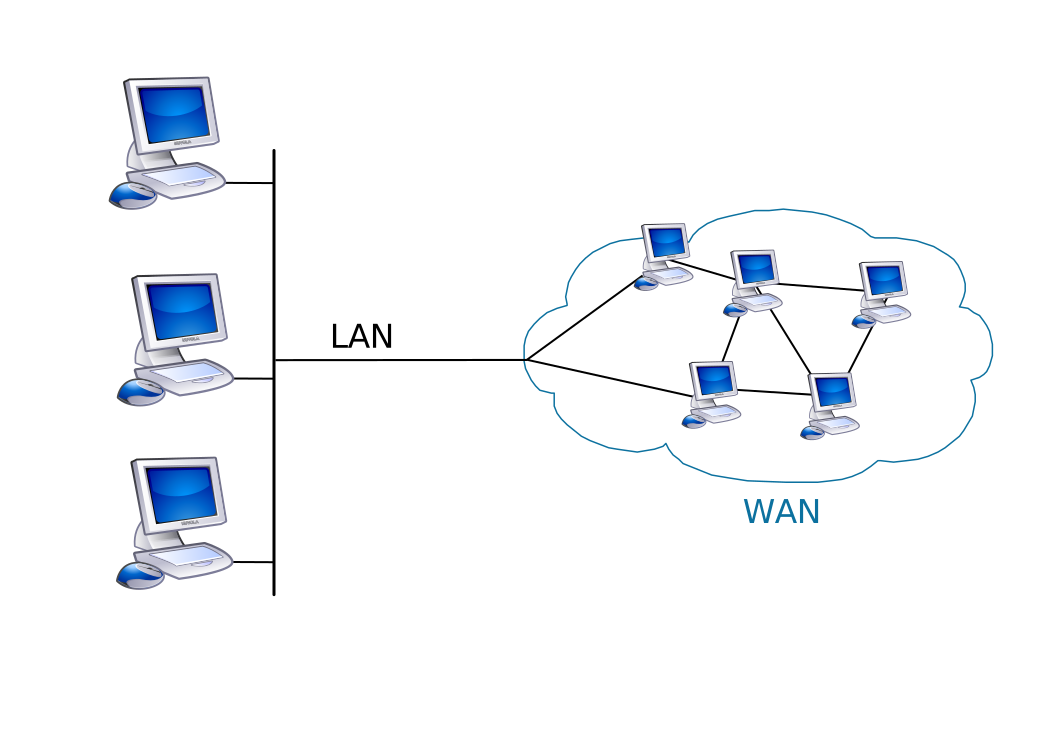
At their core, WANs function by interconnecting multiple LANs or other networks across vast distances. This is achieved through various transmission media, including fiber optic cables (both terrestrial and undersea), microwave links, and satellite communications. Routers are the critical devices that direct data traffic between different networks, making intelligent decisions about the best path for data packets to travel. Protocols like TCP/IP provide the standardized language that allows diverse networks and devices to communicate seamlessly. Technologies such as Multiprotocol Label Switching (MPLS) and Software-Defined Networking (SDN) have evolved to manage traffic more efficiently, offering greater flexibility and control over complex WAN infrastructures. The reliability and speed of a WAN are heavily dependent on the quality of the underlying circuits and the sophistication of its routing and management systems.
📊 Key Facts & Numbers
The scale of WANs is almost incomprehensible. The Internet, the largest WAN, connects billions of devices globally, with an estimated 5.3 billion internet users as of early 2024. Global internet traffic is projected to reach 1,000 exabytes per month by 2025, a staggering increase from the 3.2 zettabytes (3,200 exabytes) transmitted in 2022. The global WAN market was valued at approximately $25 billion in 2023 and is expected to grow to over $40 billion by 2028, driven by increasing demand for cloud services and remote work capabilities. Undersea fiber optic cables, spanning over 1.3 million kilometers, carry the vast majority of international data traffic, with projects like the SEA-ME-WE 3 cable system alone spanning over 39,000 kilometers.
👥 Key People & Organizations
While no single individual 'invented' the WAN, several figures and organizations were instrumental in its development. Vint Cerf and Bob Kahn are often credited as the 'fathers of the Internet' for their work on the TCP/IP protocol suite, which underpins most modern WAN communication. Early research at institutions like MIT, Stanford University, and Bell Labs contributed significantly to networking theory and practice. Major telecommunications companies like AT&T, Verizon, and Orange have historically provided the leased lines and infrastructure essential for building private WANs. Today, technology giants like Cisco Systems and Juniper Networks are key players in providing the routers, switches, and network management solutions that power global WANs.
🌍 Cultural Impact & Influence
WANs have fundamentally reshaped global culture and commerce. They enable instant communication across borders, facilitating international business, scientific collaboration, and the dissemination of information on an unprecedented scale. The rise of the Internet as a global WAN has democratized access to information and entertainment, leading to phenomena like globalized media consumption and the social media revolution. For businesses, WANs are indispensable, allowing for distributed workforces, centralized data management, and global supply chain coordination. The ability to connect disparate offices and remote workers has become a cornerstone of modern corporate strategy, impacting everything from employee productivity to customer service. The cultural impact is so profound that the absence of reliable WAN connectivity can isolate communities and hinder economic development.
⚡ Current State & Latest Developments
The WAN landscape is in constant flux, driven by demands for higher bandwidth, lower latency, and increased security. The widespread adoption of cloud computing has led to a surge in WAN traffic as organizations move data and applications off-premises. This has spurred the growth of Software-Defined WAN (SD-WAN) solutions, which offer greater agility, cost-effectiveness, and centralized management compared to traditional WAN architectures. The ongoing expansion of 5G mobile networks is also influencing WAN design, enabling new use cases for mobile connectivity and the Internet of Things (IoT). Furthermore, the increasing threat of cyberattacks necessitates continuous innovation in WAN security, with a growing focus on zero-trust architectures and advanced threat detection.
🤔 Controversies & Debates
The development and deployment of WANs are not without controversy. The concentration of control over critical internet infrastructure in the hands of a few large telecommunications companies and internet service providers raises concerns about net neutrality and equitable access. The digital divide, the gap between those with and without access to reliable internet connectivity, remains a significant global challenge, particularly in developing nations. Debates also rage over the environmental impact of massive data centers and the energy consumption of global networking infrastructure. Furthermore, the pervasive nature of WANs raises profound questions about data privacy, surveillance, and the potential for censorship, as evidenced by ongoing discussions around government access to user data and the regulation of online content.
🔮 Future Outlook & Predictions
The future of WANs points towards even greater integration, intelligence, and automation. SD-WAN is expected to become the dominant architecture, offering dynamic traffic management and seamless integration with cloud services. The rise of edge computing will further decentralize data processing, requiring WANs to efficiently connect distributed edge devices to central clouds and to each other. Artificial intelligence (AI) and machine learning will play an increasingly crucial role in optimizing WAN performance, predicting network failures, and enhancing cybersecurity. We can anticipate the development of 'self-healing' networks that can automatically detect and resolve issues, minimizing downtime. The push for global connectivity will likely continue, with initiatives aiming to bring high-speed internet to underserved regions through satellite constellations like Starlink and advanced terrestrial networks.
💡 Practical Applications
WANs are the invisible scaffolding supporting countless modern applications and services. They are essential for businesses to connect branch offices, data centers, and remote employees, enabling operations like real-time inventory management and global customer support. Educational institutions rely on WANs to provide students with access to online learning platforms, research databases, and virtual classrooms, bridging geographical barriers to education. Governments use WANs for secure communication between agencies, disaster response coordination, and the delivery of public services. Financial institutions depend on high-speed, secure WANs for transaction processing, interbank transfers, and global market access. Even everyday activities like streaming video, online gaming, and video conferencing are entirely dependent on the robust infrastructure of WANs.
Key Facts
- Year
- 1960s-Present
- Origin
- Global
- Category
- technology
- Type
- technology
Frequently Asked Questions
What is the fundamental difference between a WAN and a LAN?
The primary distinction lies in geographical scope. A Local Area Network (LAN) connects devices within a limited area, such as an office building or a home, typically using technologies like Ethernet. A Wide Area Network (WAN), on the other hand, spans much larger geographical areas, connecting multiple LANs across cities, countries, or even continents. WANs often rely on public telecommunications infrastructure, leased lines, or satellite links, whereas LANs are usually privately owned and managed.
How do companies typically build and manage their WANs?
Companies commonly build WANs by leasing dedicated circuits from telecommunications providers like AT&T or Verizon to create private networks. Alternatively, they leverage the public Internet and secure it using Virtual Private Networks (VPNs). Modern approaches increasingly involve Software-Defined WAN (SD-WAN) solutions, which offer centralized control, greater flexibility, and optimized traffic routing across various connection types, often managed through cloud-based platforms.
What are the biggest challenges facing WANs today?
Key challenges include ensuring ubiquitous and affordable access (addressing the digital divide), maintaining robust cybersecurity against evolving threats, managing the exponential growth in data traffic driven by cloud computing and IoT devices, and navigating regulatory landscapes concerning data privacy and net neutrality. The sheer complexity of managing global networks also presents significant operational hurdles.
How has the Internet evolved from a WAN concept?
The Internet is the most prominent example of a global WAN, evolving from the experimental ARPANET in the late 1960s. While ARPANET was initially a research network, the development of the TCP/IP protocol suite by Vint Cerf and Bob Kahn in the 1970s provided a universal standard for interconnecting diverse networks. This open architecture allowed the Internet to grow organically into a vast, decentralized WAN connecting billions of devices worldwide, fundamentally changing global communication.
What is the role of routers in a WAN?
Routers are indispensable devices in WANs; they act as traffic directors, connecting different networks and forwarding data packets to their intended destinations. When a data packet arrives at a router, the router examines its destination IP address and consults its routing table to determine the most efficient path to send the packet along. This process is repeated at each hop across the WAN, ensuring that data traverses the complex network topology effectively, much like a postal service sorting and directing mail.
How can I ensure my business's data is secure when using a WAN?
Securing data on a WAN involves a multi-layered approach. Implementing strong Virtual Private Networks (VPNs) encrypts data in transit, making it unreadable to unauthorized parties. Employing robust firewalls at network perimeters and internal segments helps block malicious traffic. Access control lists (ACLs) and identity and access management (IAM) systems ensure only authorized users and devices can access network resources. Regular security audits, intrusion detection systems, and employee training on cybersecurity best practices are also critical components.
What are the future trends for WAN technology?
Future WANs will be increasingly defined by SD-WAN adoption, greater integration with cloud services, and the rise of edge computing. AI and machine learning will be leveraged for network automation, predictive maintenance, and enhanced security. We'll also see continued efforts to expand global connectivity, potentially through advanced satellite networks like Starlink, aiming to bridge the digital divide and support the burgeoning IoT ecosystem with higher bandwidth and lower latency.