
Contents
Overview
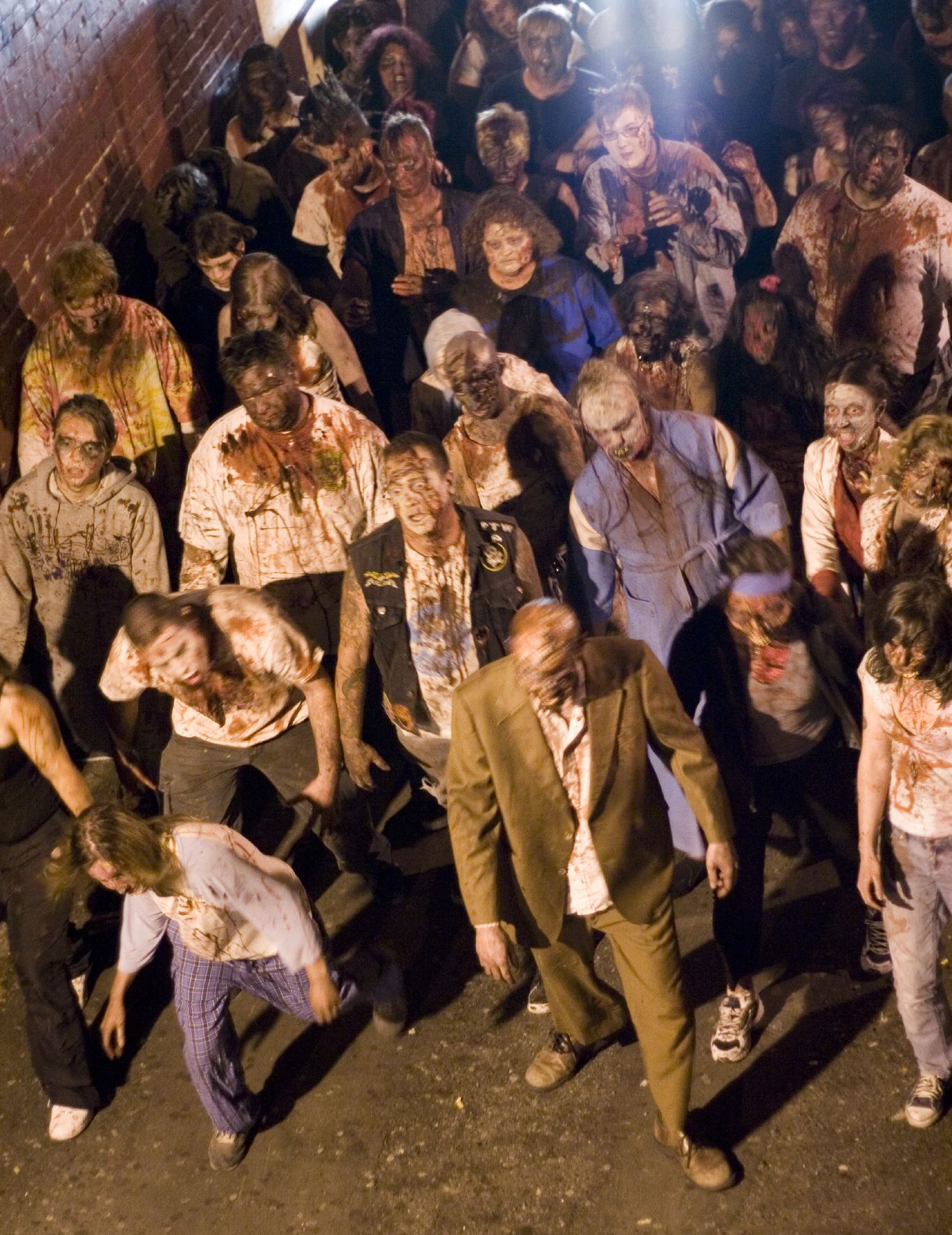
Zombie apocalypse fiction is a potent subgenre of speculative fiction depicting the collapse of civilization under the onslaught of reanimated corpses, or zombies. This narrative framework, typically featuring small bands of survivors battling overwhelming hordes, explores themes of societal breakdown, human nature under duress, and the primal struggle for existence. While Night of the Living Dead drew inspiration from Richard Matheson's novel I Am Legend, the genre has evolved dramatically, encompassing diverse causes for the outbreak—from viral pandemics and parasitic infections to supernatural phenomena. Its enduring appeal lies in its ability to serve as a visceral metaphor for contemporary anxieties, from public health crises and environmental collapse to political polarization and the erosion of social order. The genre has proliferated across media, including countless films, television series like The Walking Dead, video games such as Resident Evil, and a vast library of novels and comic books, solidifying its status as a dominant force in popular culture.
🎵 Origins & History
The genesis of the modern zombie apocalypse narrative is inextricably linked to George A. Romero's groundbreaking work. While earlier works like Richard Matheson's novel I Am Legend explored similar themes of societal collapse due to a monstrous plague, Romero's films cemented the image of the flesh-eating, shambling undead as a relentless, overwhelming force. Precursors can also be found in Haitian folklore concerning the concept of the voodoo zombi, though the modern iteration is largely a secularized, biological horror. The 2002 film 28 Days Later, directed by Danny Boyle, revitalized the genre by introducing faster, more aggressive infected, challenging the established slow-moving zombie archetype.
⚙️ How It Works
At its core, a zombie apocalypse narrative hinges on a catastrophic event that unleashes an unstoppable, or nearly unstoppable, horde of the undead. The cause varies wildly: viral outbreaks (as seen in Resident Evil and The Strain), parasitic infections (like in The Host or World War Z), scientific experiments gone awry, or even supernatural curses. The key mechanic is the infectious nature of the zombies; typically, a bite or scratch from an infected individual transmits the pathogen, turning the victim into one of the horde. This creates a constant, escalating threat where survival depends on resourcefulness, evasion, and often, brutal combat. The narrative frequently focuses on the breakdown of societal structures—governments, law enforcement, and infrastructure—leaving isolated groups of survivors to fend for themselves, forging new, often precarious, communities or succumbing to internal strife and external threats.
📊 Key Facts & Numbers
The zombie apocalypse genre has seen a significant proliferation of media. The Walking Dead alone spawned multiple spin-offs. The Resident Evil video game series has been a major success. Globally, zombie-themed media generates substantial revenue. Surveys indicate that a significant portion of the population in Western countries expresses familiarity with the zombie apocalypse trope. During the COVID-19 pandemic, searches for 'zombie apocalypse' on Google Trends saw a significant spike, increasing by over 300% in some regions.
👥 Key People & Organizations
Beyond George A. Romero, who is undeniably the genre's patriarch, key figures include Richard Matheson, whose novel I Am Legend provided foundational thematic elements. In film, directors like Danny Boyle (for 28 Days Later) have significantly shaped the genre. Television has been dominated by The Walking Dead, executive produced by Robert Kirkman, who also penned the comic book series. Game developers like Capcom with their Resident Evil series have been instrumental in popularizing the genre in interactive media.
🌍 Cultural Impact & Influence
The zombie apocalypse serves as a powerful cultural mirror, reflecting societal anxieties and fears. Its enduring popularity stems from its ability to explore themes of survival, morality, and the fragility of civilization in a visceral, engaging way. The genre has permeated mainstream culture, influencing everything from disaster preparedness campaigns to political discourse. It allows audiences to grapple with existential threats in a fictionalized, controlled environment, providing catharsis and prompting reflection on our own societal structures and vulnerabilities. The trope has also spawned numerous parodies and subversions, demonstrating its deep integration into the cultural lexicon, seen in works like Shaun of the Dead.
⚡ Current State & Latest Developments
In 2024 and 2025, the zombie apocalypse genre continues its robust presence across media. The television landscape remains strong with ongoing series like The Walking Dead universe spin-offs and new entries in the genre. Video games continue to be a major frontier, with titles like The Last of Us Part II pushing narrative boundaries and achieving critical acclaim, while new zombie-survival games are constantly being released on platforms like Steam. Film studios are actively developing new zombie features and reboots, seeking to capture the genre's commercial appeal. The increasing realism of CGI and special effects allows for more terrifying and convincing portrayals of the undead, keeping the genre fresh for audiences.
🤔 Controversies & Debates
The genre is not without its controversies and debates. A significant point of contention is the evolution of the zombie itself: the shift from slow, shambling corpses to fast, aggressive infected has been criticized by purists who feel it dilutes the core essence of the genre, which often relies on the overwhelming nature of slow-moving hordes. Another debate centers on the genre's increasing reliance on human antagonists over the undead, with some arguing that the real horror lies in humanity's capacity for cruelty under pressure, while others lament the loss of focus on the zombie threat itself. Ethical discussions also arise regarding the portrayal of violence and the often bleak, nihilistic outlook presented in many zombie narratives, particularly concerning their impact on younger audiences.
🔮 Future Outlook & Predictions
The future of zombie apocalypse fiction appears to be one of continued evolution and diversification. Expect to see more experimental narratives that blend the genre with other subgenres, such as science fiction, fantasy, or even romantic comedy. The increasing focus on character-driven stories and complex moral dilemmas, as seen in The Last of Us franchise, is likely to persist, offering deeper explorations of the human condition amidst the chaos. Furthermore, advancements in virtual reality technology could usher in a new era of immersive zombie experiences, blurring the lines between fiction and reality. The genre's adaptability suggests it will continue to find new ways to resonate with contemporary anxieties, from pandemics and climate change to technological singularity and societal collapse.
💡 Practical Applications
While primarily a form of entertainment, zombie apocalypse fiction has surprisingly practical applications. The genre has been utilized by public health organizations, such as the CDC, to create engaging public awareness campaigns about disaster preparedness, using the fictional threat of zombies to educate citizens on practical steps for surviving real-world emergencies like hurricanes or pandemics. Military and emergency response planners have also used zombie apocalypse scenarios as theoretical exercises to test and refine their response strategies to widespread societal disruption and the breakdown of essential services. The problem-solving and strategic thinking inherent in surviving a zombie apocalypse can also be applied to business strategy and crisis management training, encouraging innovative thinking under pressure.
Key Facts
- Category
- culture
- Type
- topic