
Contents
Overview
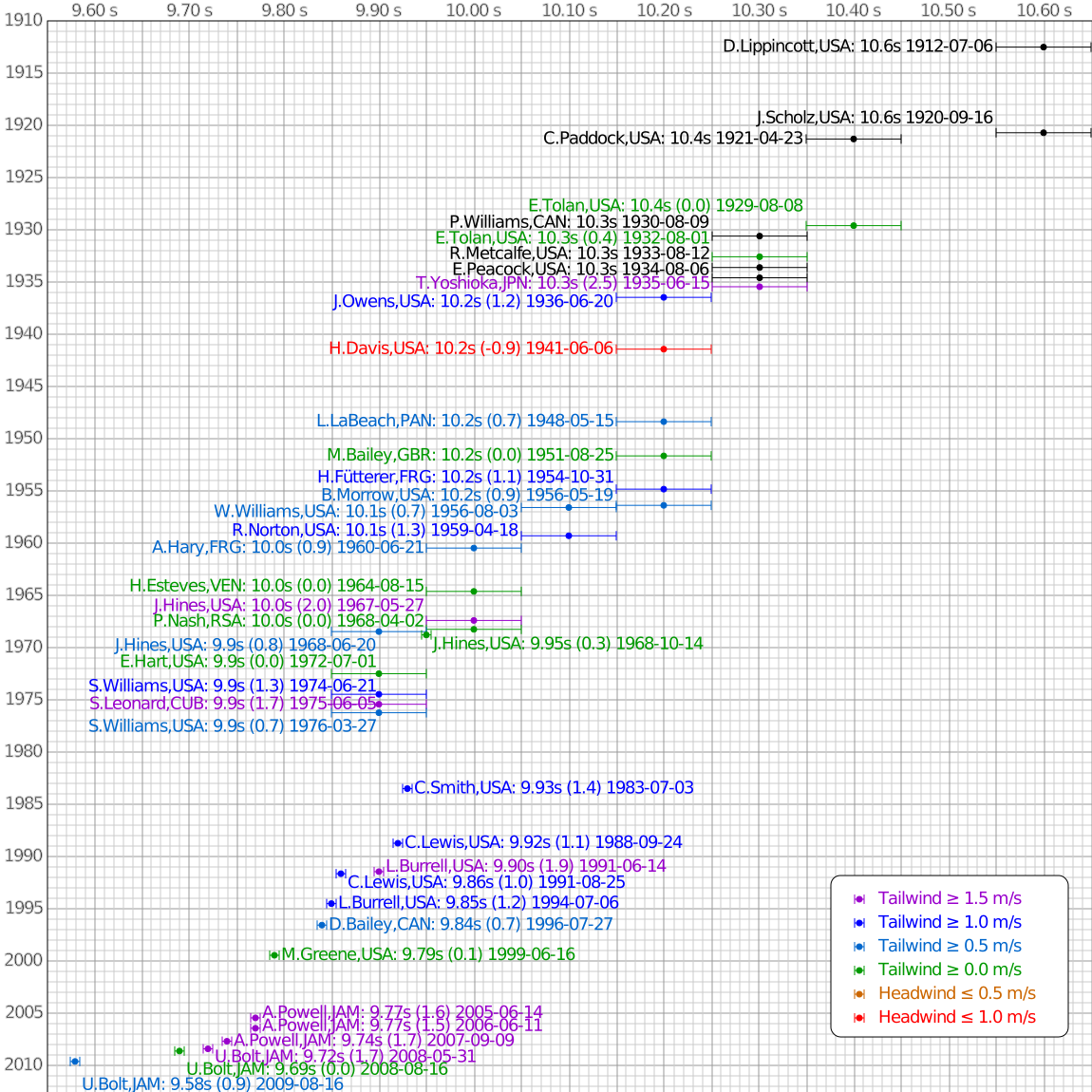
The 100-meter dash world record represents the pinnacle of human speed, a benchmark constantly pushed by elite athletes. First officially recognized by the International Amateur Athletics Federation (IAAF), now World Athletics, in 1912, the record has seen a dramatic progression, largely driven by advancements in training, nutrition, and track technology. The current men's record stands at an astonishing 9.58 seconds, set by Usain Bolt of Jamaica at the 2009 IAAF World Championships in Berlin. For women, the record is 10.49 seconds, held by Florence Griffith-Joyner of the United States since 1988. These records are not merely numbers; they are cultural touchstones, celebrated in Olympic Games and major athletic events worldwide, captivating audiences with the raw display of athletic power and determination. The quest to shave off even a hundredth of a second fuels intense competition and scientific inquiry into biomechanics and human potential.
🎵 Origins & History
The official history of the 100-meter world record begins in 1912 when the International Amateur Athletics Federation (IAAF), now World Athletics, began ratifying performances. Before this, records were less formally documented, but early sprinters like Charles Paddock were already pushing boundaries. Over the decades, the record has been chipped away incrementally, with significant leaps often attributed to rule changes, improved track surfaces like the Tartan track, and revolutionary training methodologies pioneered by coaches such as Ettore Ferrari. The transition from hand-timing to electronic timing in the late 1970s also brought greater precision and legitimacy to record-breaking performances, solidifying the quest for the sub-10-second barrier for men and sub-11 for women as a central narrative in track and field.
⚙️ How It Works
The 100-meter race is a pure test of explosive power, acceleration, and top-end speed. Athletes begin from a stationary start in starting blocks, designed to maximize initial propulsion. The race is divided into three phases: acceleration (first 20-30 meters), maximum velocity (roughly 30-70 meters), and deceleration (last 20-30 meters), where maintaining form is crucial to minimize speed loss. Factors influencing performance include reaction time to the gun, stride length and frequency, aerodynamic drag, and the athlete's ability to withstand the physiological stress of maximal effort. The kinetic chain, from the initial push-off to the final lean at the finish line, must be perfectly synchronized. Biomechanics plays a critical role, with athletes and coaches analyzing every movement to optimize efficiency and power output, often utilizing advanced motion-capture technology for detailed analysis.
📊 Key Facts & Numbers
As of my last update, the men's 100m world record is 9.58 seconds, set by Usain Bolt on August 16, 2009, at the IAAF World Championships in Berlin. This performance represented a 0.11-second improvement on his previous record. The women's record stands at 10.49 seconds, achieved by Florence Griffith-Joyner on July 16, 1988, at the U.S. Olympic Trials in Indianapolis. Since 1912, the men's record has been lowered by approximately 1.02 seconds, while the women's record has decreased by about 0.61 seconds. The IAAF (now World Athletics) has ratified over 67 men's records and a significant number for women, though exact figures fluctuate with new validations. The average improvement per ratified record for men has been around 0.015 seconds, highlighting the diminishing returns as human speed approaches theoretical limits.
👥 Key People & Organizations
Key figures in the 100m world record narrative include Usain Bolt, whose electrifying performances redefined sprinting. His coach, Glen Mills, is credited with refining his technique and maximizing his potential. For the women's record, Florence Griffith-Joyner remains an iconic figure, though her record has stood for decades. Carl Lewis was another dominant force, holding the record briefly and achieving legendary status. Jesse Owens also set remarkable times in his era. Organizations like World Athletics are crucial for standardizing rules, ratifying records, and organizing major competitions like the Olympic Games and World Athletics Championships. The International Olympic Committee (IOC) also plays a pivotal role in the global recognition of athletic achievements.
🌍 Cultural Impact & Influence
The 100m world record is more than just an athletic feat; it's a global cultural phenomenon. The winner of the men's 100m at the Olympic Games is often dubbed the 'fastest man in the world,' a title carrying immense prestige. These records capture the public imagination, appearing in news headlines, sports documentaries, and even inspiring popular culture, from movies to music. The pursuit of speed has also driven innovation in sports science, leading to advancements in sports nutrition, exercise physiology, and athletic footwear design. The iconic image of Usain Bolt celebrating his records has become globally recognized, symbolizing peak human achievement and inspiring millions to pursue their athletic dreams. The narrative of breaking barriers and pushing limits resonates deeply across diverse cultures.
⚡ Current State & Latest Developments
The current landscape for the men's 100m record is intensely competitive, with athletes like Noah Lyles, Fred Kerley, and Christian Coleman consistently running under 10 seconds. While Bolt's 9.58 remains a formidable target, the depth of talent suggests it could eventually be challenged. For women, Shelly-Ann Fraser-Pryce and Elaine Thompson-Herah have achieved incredible times in recent years, nearing Florence Griffith-Joyner's long-standing record. Advancements in track-and-field technology, including improved track surfaces and sophisticated training analytics, continue to aid athletes. The focus remains on optimizing the delicate balance between raw power and refined technique to eke out those crucial hundredths of a second.
🤔 Controversies & Debates
The most persistent controversy surrounding the 100m world record involves doping allegations and the use of performance-enhancing drugs. Florence Griffith-Joyner's 10.49 record, in particular, has faced scrutiny due to its significant margin over previous marks and the subsequent doping scandals that plagued athletics in the late 1980s and 1990s. Similarly, questions have been raised about the validity of certain records set during eras with less stringent testing protocols. The role of advanced technologies in training and equipment also sparks debate, with discussions on whether innovations like specialized running shoes or advanced training methods provide an unfair advantage. The debate over the 'cleanliness' of records is ongoing, impacting how fans and historians perceive these monumental achievements.
🔮 Future Outlook & Predictions
The future of the 100m world record hinges on a confluence of biological limits and technological advancements. Some biomechanical models suggest that human speed may be approaching its absolute ceiling, making further significant reductions in the record increasingly difficult. However, breakthroughs in genetics, sports psychology, and wearable technology could unlock new potential. Athletes might benefit from personalized training regimens informed by real-time physiological data, or even genetic predispositions identified through advanced screening. The development of even faster track surfaces or revolutionary athletic apparel could also play a role. Predicting a specific time is speculative, but the pursuit will undoubtedly continue, fueled by the innate human desire to transcend perceived limits, potentially seeing records fall by mere thousandths of a second.
💡 Practical Applications
While the 100m world record itself isn't a direct 'application,' the pursuit of it drives innovation with practical implications across various fields. The advanced training methodologies developed for sprinters, focusing on explosive power, acceleration, and efficiency, are adapted for athletes in numerous other sports, from basketball to football. The biomechanical analysis techniques used to study sprinting inform rehabilitation protocols for sports injuries and the design of prosthetics for para-athletes. Furthermore, the development of high-performance [[athle
Key Facts
- Category
- sports
- Type
- topic