
Contents
- 🎵 Origins & History
- ⚙️ How It Works
- 📊 Key Facts & Numbers
- 👥 Key People & Organizations
- 🌍 Cultural Impact & Influence
- ⚡ Current State & Latest Developments
- 🤔 Controversies & Debates
- 🔮 Future Outlook & Predictions
- 💡 Practical Applications
- 📚 Related Topics & Deeper Reading
- Frequently Asked Questions
- References
- Related Topics
Overview
The genesis of Athenian democracy wasn't a single eureka moment but a protracted evolution, primarily spanning the 6th and 5th centuries BC. Precursors to democracy existed, but the radical shift began with Solon's reforms around 594 BC, which aimed to alleviate social unrest by canceling debts and restructuring the citizenry into wealth-based classes, granting political rights accordingly. However, it was Cleisthenes who, in 508–07 BC, is widely credited with establishing the foundational structures of democracy by reorganizing the Athenian citizenry into ten tribes based on geography rather than kinship, thereby breaking the power of aristocratic families. Further significant reforms by Ephialtes in 462 BC stripped the aristocratic Areopagus council of its most important powers, transferring them to the citizen Assembly and the popular courts, solidifying the direct democratic model. This system was not unique; by the late 4th century BC, it's estimated that up to half of the over one thousand Greek city-states may have adopted some form of democratic governance, though Athens's system became the most studied and influential.
⚙️ How It Works
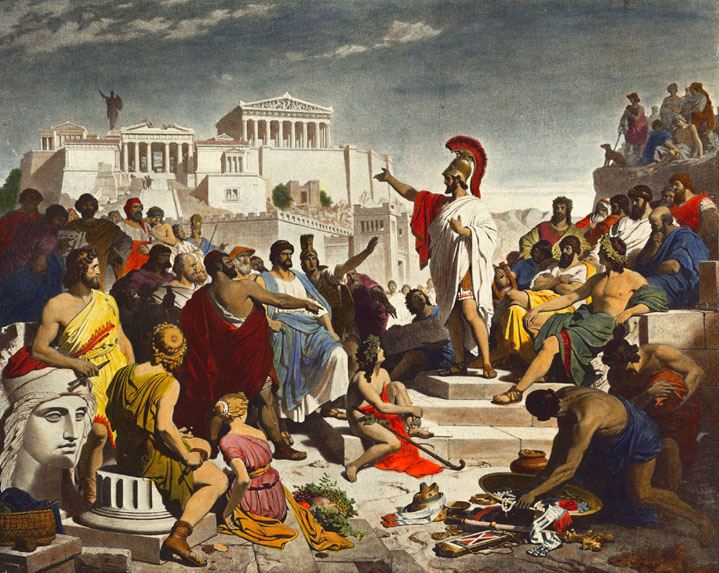
Athenian democracy operated on the principle of direct participation, a stark contrast to modern representative systems. The cornerstone was the Assembly (Ekklesia), open to all free adult male citizens, where they debated and voted on laws, foreign policy, and ostracism (temporary banishment of citizens deemed a threat). Executive and administrative roles were often filled by lot from among the citizenry, a method designed to prevent the entrenchment of power and ensure broad participation; officials served for short terms, typically one year, and were subject to scrutiny (euthyna) upon leaving office. The popular courts (Heliaia), composed of hundreds of citizens chosen by lot, held significant judicial power, hearing both private and public cases. This system, while empowering citizens, relied on a relatively small, enfranchised male population to manage the affairs of the state, with an estimated 30-40% of the total population being eligible to participate.
📊 Key Facts & Numbers
The scale of Athenian democracy was significant for its time, though limited by modern inclusivity standards. At its peak, the citizen body eligible to vote in the Assembly numbered around 30,000 to 60,000 individuals. The Assembly could convene as many as 40 times a year, with attendance sometimes reaching 6,000 citizens for crucial votes. The Council of 500 (Boule), responsible for preparing the Assembly's agenda, comprised 50 citizens from each of the ten tribes, selected by lot annually. Juries in the popular courts could consist of hundreds, even thousands, of citizens; for instance, a jury of 501 was common for many cases. Despite this broad participation among citizens, women, metics (resident foreigners), and slaves, who constituted the majority of Athens's population, were excluded from political life, a fact that underscores the inherent limitations of this ancient system.
👥 Key People & Organizations
Several key figures and institutions shaped Athenian democracy. Solon, an archon in 594 BC, laid early groundwork by reforming laws and economic policies to reduce inequality. Cleisthenes, an aristocrat from the Alcmaeonidae family, is credited with establishing the democratic constitution around 508 BC, reorganizing the tribal system. Ephialtes's reforms in 462 BC significantly curtailed the powers of the aristocratic Areopagus council, empowering the Assembly and courts. Pericles, a prominent statesman and general during Athens's Golden Age (mid-5th century BC), championed democratic ideals and introduced pay for jury service, enabling poorer citizens to participate. The Assembly, the Council of 500, and the popular courts were the primary institutional pillars of the democratic system.
🌍 Cultural Impact & Influence
The influence of Athenian democracy on subsequent political thought and practice is immeasurable, despite its inherent flaws. It provided the first large-scale, documented example of a system where citizens directly governed themselves, influencing Enlightenment thinkers like Jean-Jacques Rousseau and John Locke, who grappled with concepts of popular sovereignty and the social contract. The very term 'democracy' derives from the Greek 'demos' (people) and 'kratos' (rule). While modern democracies are largely representative, the Athenian ideal of active citizen engagement and accountability continues to resonate, inspiring movements for greater civic participation and direct democracy, even as its exclusionary nature serves as a perpetual cautionary tale. The philosophical debates surrounding justice, citizenship, and the common good, as articulated by figures like Plato and Aristotle, were deeply intertwined with their observations of Athenian political life.
⚡ Current State & Latest Developments
While Athenian democracy as a direct political system ceased to exist with the decline of the city-state and subsequent conquests by Philip II of Macedon and later Rome, its legacy is far from dormant. Contemporary discussions about direct democracy often reference Athens, particularly in the context of digital platforms that could potentially facilitate large-scale citizen deliberation and voting. Movements advocating for greater citizen involvement in decision-making, participatory budgeting initiatives in cities like Porto Alegre, and online governance experiments can be seen as modern echoes of the Athenian experiment. The ongoing debate about the balance between direct participation and representative governance, and the challenges of ensuring inclusivity and preventing mob rule, remain central to understanding the enduring relevance of Athenian democratic principles.
🤔 Controversies & Debates
Athenian democracy is fraught with controversy, primarily concerning its exclusivity and the potential for instability. Critics, both ancient and modern, point to the exclusion of women, slaves, and foreigners as a fundamental flaw, rendering it an 'elite democracy' rather than a truly universal system. Philosophers like Plato famously critiqued democracy, arguing in his work The Republic that it could devolve into mob rule and lead to the election of incompetent leaders, ultimately paving the way for tyranny. The practice of ostracism, while intended to protect the democracy, could be wielded as a tool for political vendettas. Furthermore, the direct nature of decision-making, while empowering, could also lead to impulsive or ill-considered policies, as argued by some historians analyzing events like the Peloponnesian War.
🔮 Future Outlook & Predictions
The future of democratic governance will undoubtedly continue to grapple with the legacy of Athens. As technology advances, the potential for more sophisticated forms of direct or liquid democracy increases, allowing citizens to vote directly on issues or delegate their votes to trusted experts. However, the challenges of ensuring informed participation, preventing the manipulation of public opinion through misinformation (a concern even in ancient Athens), and maintaining stability in large, diverse populations remain significant hurdles. The Athenian model, with its emphasis on civic duty and direct engagement, serves as a constant reminder that the health of any democracy depends not just on its structures but on the active, informed, and responsible participation of its citizenry. The question of how to balance direct citizen input with the need for expert knowledge and efficient governance will likely define democratic evolution for decades to come.
💡 Practical Applications
The principles and practices of Athenian democracy find echoes in various modern applications, albeit often in modified forms. The concept of jury duty in many legal systems, where ordinary citizens are tasked with judging their peers, directly descends from the Athenian popular courts. Participatory budgeting, a process where citizens decide how to spend a portion of a public budget, is a contemporary manifestation of direct citizen involvement in resource allocation, reminiscent of how the Athenian Assembly managed state funds. Furthermore, the rise of online platforms and civic-tech initiatives aims to facilitate greater citizen deliberation and input into policy-making, drawing inspiration from the Athenian ideal of an engaged citizenry. Even the structure of some non-profit organizations and cooperatives, with their emphasis on member participation and consensus-building, can trace a lineage back to the communal decision-making processes of the ancient polis.
Key Facts
- Year
- 6th-4th centuries BC
- Origin
- Athens, Greece
- Category
- history
- Type
- concept
Frequently Asked Questions
Who was eligible to participate in Athenian democracy?
Participation in Athenian democracy was restricted to free adult male citizens. This meant that women, slaves, and resident foreigners (metics) were excluded from political life, despite constituting the majority of Athens's population. While the exact numbers fluctuated, the eligible citizen body likely numbered between 30,000 and 60,000 at its peak, representing a significant portion of the adult male population but a much smaller fraction of the total populace.
What was the difference between Athenian democracy and modern democracy?
The fundamental difference lies in direct versus representative participation. Athenian democracy was direct: citizens themselves debated and voted on laws in the Assembly (Ekklesia). Modern democracies are primarily representative, where citizens elect officials to make decisions on their behalf. Athenian democracy also relied heavily on selection by lot for many offices, a practice rarely used today, and its franchise was far more restricted than in most modern states.
What were the main institutions of Athenian democracy?
The core institutions included the Assembly (Ekklesia), where all eligible citizens could speak and vote on legislation; the Council of 500 (Boule), which prepared the Assembly's agenda and managed daily administration; and the popular courts (Heliaia), composed of hundreds of citizens chosen by lot to serve as jurors. Many magistracies were also filled by lot, ensuring broad citizen involvement in governance.
Was Athenian democracy truly 'rule by the people'?
While it was a radical experiment in self-governance for its time, 'rule by the people' is debatable given its exclusivity. Only a fraction of Athens's total population—free adult males—could participate. The vast majority, including women, slaves, and metics, were excluded. Therefore, it was more accurately 'rule by the male citizenry' rather than the entire populace, a limitation frequently critiqued by ancient philosophers and modern historians alike.
What criticisms did ancient philosophers have of Athenian democracy?
Prominent philosophers like Plato were highly critical, arguing in The Republic that democracy could lead to chaos, the elevation of the unqualified, and ultimately, tyranny. He believed that governance required specialized knowledge and virtue, which the masses, swayed by rhetoric and emotion, often lacked. Aristotle, while more nuanced, also identified potential dangers, such as the risk of the poor majority oppressing the wealthy minority.
How did citizens participate in Athenian democracy?
Citizens participated directly by attending and speaking in the Assembly (Ekklesia), voting on laws and policies, and serving on the Council of 500 (Boule) or as jurors in the popular courts (Heliaia). Many administrative and judicial positions were filled by lot, requiring citizens to serve when chosen. This direct engagement was central to the functioning and ethos of Athenian democracy.
What is the lasting legacy of Athenian democracy?
The enduring legacy of Athenian democracy lies in its pioneering status as a large-scale, functioning system of direct citizen rule and its profound influence on Western political thought. Concepts like popular sovereignty, civic duty, and the ideal of an engaged citizenry, though imperfectly realized in Athens, continue to shape democratic aspirations worldwide. It serves as both an inspiration for direct participation and a cautionary tale regarding inclusivity and the potential pitfalls of unchecked popular will.